From NC State to the Moon: An Aspiring Astronaut Interviews NASA Astronaut Christina Koch
What does it really take to become a NASA astronaut? From building trust in zero gravity and balancing hobbies like rock climbing and surfing, to dealing with imposter syndrome and navigating career choices, Christina Koch shares advice for aspiring astronauts everywhere.

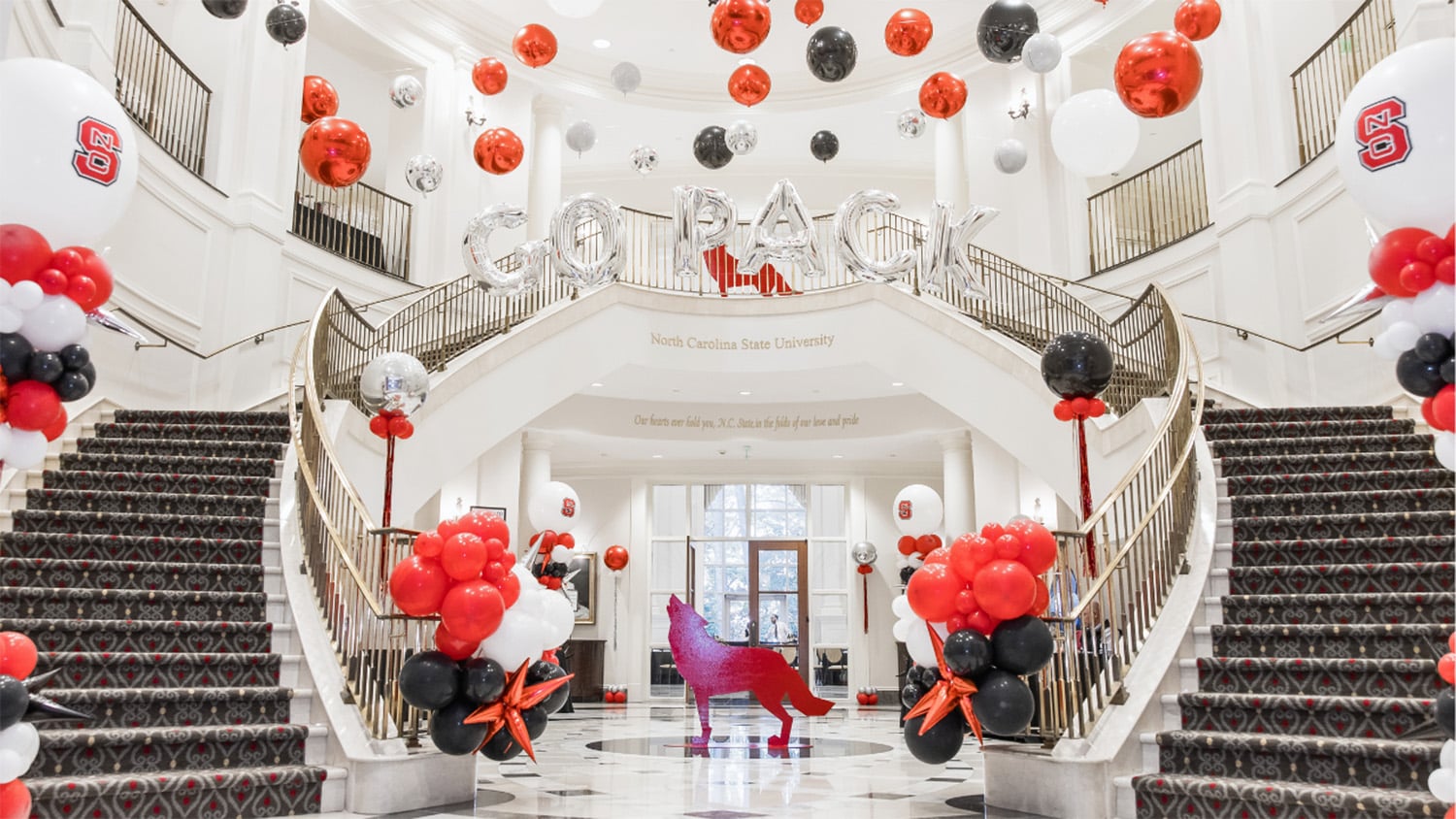
When NASA astronaut Christina Koch returned to her alma mater in August 2026 following the historic Artemis II mission, NC State celebrated big. During her visit, the university renamed Engineering Building II to Christina Hammock Koch Hall. Just hours after the announcement, NC State senior and two-time NASA intern Raina Gandhi sat down with Koch at Hunt Library. Their conversation covers building trust in extreme environments, overcoming imposter syndrome and pursuing passions outside of work and school. Watch the full video above or read the full transcript below.
Transcript
Raina Gandhi: So I’m a rising fourth year studying mechanical engineering and psychology. And I’ve always dreamed about being an astronaut, but it seemed a little bit out of reach. And then I see someone that’s been to my school and has accomplished it and it feels like this is the path I’m going to take in life.
Christina Koch: Wow.
Raina Gandhi: Who inspired you on your journey to become an astronaut?
Christina Koch: Well, that’s an amazing story, Raina. It’s so nice to meet you. And I love that your double majors are, I would say, unconventional to put together. So that’s amazing and so important at the same time. I had so much inspiration along the way and then I also had a lot of support along the way. So both of those things are so important. Inspired by my parents, inspired by my grandmother. She was an incredibly-
Raina Gandhi: Yes.
Christina Koch: … hard worker. She’s a farmer. Inspired by, actually in particular, while I was in college here, I got really into the leaders of the civil rights movement and learning a lot about that and how so many of them are from this area. Ella Baker and roots at Shaw University. That was so inspiring to me because I just couldn’t imagine how brave you would have to be to just fearlessly go towards what you know is right, even despite whatever environment you’re in. And even knowing that it could be dangerous, just so inspiring.
Professors that I had here that believed in me, I had physics professors, electrical engineering professors, all of whom encouraged me, even though to approach a professor telling them you want to be an astronaut is probably something they… I would imagine there could be a potential to approach that with a little more realism. And none of them felt the need to discourage me, which was really amazing. Cecilia Townsend, Dr. Blondin, Steve Reynolds, these are some names that come to mind from my time here that inspired me to keep towards my dream, even if I had an unconventional path to get there. So too many to name.
Raina Gandhi: I love that.
Christina Koch: So many people.
Raina Gandhi: The strength of the wolf is in the Pack.
Christina Koch: Yeah, that’s right. Exactly. And I absolutely loved that I was called one of the Pack today.
Raina Gandhi: Yeah, you are.
Christina Koch: And I really felt that and that was a beautiful thing. Obviously that’s one of the most important things that you can bring to anything that you approach is just a sense of teamwork and crew mates and being a part of something greater than yourself and both giving back to that and having that be your primary focus, but also accepting the support and the inspiration from people around you.
Raina Gandhi: Yeah. I really admire your mindset. Mindset is so important and the attitude you have towards your work is incredible.
Christina Koch: Thank you.
Raina Gandhi: So next question. In my psychology courses, we talk a lot about interpersonal relationships.
Christina Koch: Yes.
Raina Gandhi: I thrive on deep connections. Now in space, you’re forced to bond with a small number of people in extreme conditions. So how do you build that level of trust with your crew mates and has it changed the way that you see relationships on earth?
Christina Koch: Well, what a phenomenal thing to get to talk about. Trust could not be more important than in the human spaceflight program.
Raina Gandhi: Yeah.
Christina Koch: It’s between each other as crew mates, but it’s also between you and the people that built your vehicle and the leaders that are making the decisions on the big milestones of your mission. So it’s the thread that runs through absolutely everything we do and we treat it with that level of importance. We never outrun trust. And that’s something that I came to realize as a phrase that describes our approach towards the end of our training where really the goal is yes, we have so many technical things to learn and they’re so important. Obviously number one, and goes without saying, minimum qualification is knowing your job and the spacecraft and all that, but more importantly, to never outrun the trust that you’ve built with each other and focus on the wrong things. So as a crew, we were always really focused on open and honest feedback with each other.
Raina Gandhi: Yeah.
Christina Koch: We value feedback, both giving and receiving it as just the highest thing that you can imagine, to give feedback and to be brave enough to give feedback is such a gift and how to receive that feedback to promote more of it because we all really, the premise of all that is that we are all trying to achieve excellence and high performance and all that is all to give back to the mission. And just that mindset. I’ll give an example about trust. As you might have heard, if you were following along with the mission, there were some issues that were found on the heat shield of the Artemis one space capsule. Our leaders were faced with the decision of how to approach our mission, whether we would keep the heat shield that we had, knowing that it had some deficiencies that we discovered, or could we even safely make operational workarounds to accept that? Or would we take a step back in our schedule to design a new heat shield and replace it?
We actually met constantly with the team that was doing that investigation as the crew members, as the people on board. We had these very open conversations with them about we’re not going to rush to any decision about what we’re going to do until we understand the root cause. And they completely modeled their entire investigation after that premise that we really just came up with together. Until we understand root cause, we’re not even going to talk about what we do in terms of the mission. And that really was the core, the kernel of our trust that they agreed to take this on with that in mind because that was the only way we would come to the right decision that we put an understanding first, even if that meant that this whole investigation might be more difficult or take longer. And the fact that they went on that ride with us and for us really built that trust and we just applied that everywhere we went.
Raina Gandhi: I’m hearing it’s not about checking boxes, it’s about taking the time to do the most excellent work you can.
Christina Koch: Definitely. And showing up for each other and voicing it when it doesn’t happen. That’s the feedback component. So there’s so many elements there.
Raina Gandhi: Okay. So I’ve watched several of your interviews of course, and the way you describe seeing Earth from space is so inspiring. It gives me the sense of pure possibility. So now that you’re back on earth, how do you hold on to that feeling of wonder?
Christina Koch: That is the ultimate question that I ask myself every day. I was speaking earlier with some folks and explaining that when I first came back, my biggest fear was about this beautiful thing that I just got to experience fleeting away and that it would never be closer than it was in that moment. And how can I just have the most likelihood of getting to hold onto it and having it be real? And really to answer your question, I just take time and I actually sit with that. I try to put myself back into the feeling of looking out and actually seeing the crescent earth out the real window because by now I’ve seen so many photographs of it that in some ways those photos have become more prevalent in my mind than the actual moments there.
Raina Gandhi: Experience. Yeah.
Christina Koch: And so just chair flying the mission, and I can talk about that another time what I mean by chair flying, but just trying to literally put myself in the moment of experiencing that wonder and what was it like the first second we saw that? I did a lot of journaling in the first two weeks after coming back from the mission. I didn’t look at any photographs at all for two weeks because I wanted to write down what I remembered.
Raina Gandhi: I love that.
Christina Koch: And also talking with my crew mates. My crew mates and I, we will forever be best friends, but we still, every once in a while, there might be a group text or when we’re together, we might just recall something, whether it’s something funny or a moment of wonder that just brings you back.
Raina Gandhi: Any funniest stories that you haven’t shared that come to mind?
Christina Koch: Oh my gosh. There’s so many. Well, we shared one recently about the first time that our crew mate, Jeremy, we’ll say, fully utilized the toilet on board the space capsule.
Raina Gandhi: I saw that one. Yes.
Christina Koch: And he basically, totally, fully knowing what he was going to do to us, pranked the heck out of us by putting on a full set of protective gear before this operation and then popping out of the hygiene bay, which means he popped out of the floor and was like, “All right guys, I think I’m ready.” And yeah. I’ve never cried that hard in space before. So that’s a great moment. There’s just too many to remember. There were some memes actually after the mission of what could be that funny in space where I’m laughing. I don’t remember what these things were, but my crew mates are hilarious and we just had so much fun. There’s so much joy.
Raina Gandhi: Do the tears in space…
Christina Koch: They do not fall. They well up around your eyes. Yes. And I had plenty of moments. I was crying all the time in space and I’m super proud of that. And there was a lot to have emotions about and you should definitely always have your emotions. I think I cried the most when I was opening the letters from my nieces, nephews, and family members. So they were kind enough. I asked them for handwritten letters. I mean, when, talk about bawling your eyes out, reading these incredible letters from my family and yeah, the tears just just stay there and you just have to keep dabbing them. They’re not going to run down. They’re not going to help you out.
Raina Gandhi: Aside from being a student here, I’m also a Division 1 gymnast. And-
Christina Koch: Amazing.
Raina Gandhi: … I know staying active is really important to you from surfing to rock climbing.
Christina Koch: Yes.
Raina Gandhi: Can you talk about the importance of making time for these passions aside from work or the classroom?
Christina Koch: 100%. This is something I am passionate about. I also find a lot of fulfillment in having different hobbies and especially ones that focus on healthy habits. It’s something that I think it’s so symbiotic. It builds on itself to have healthy habits in your full life really just makes you your best performer, whether that’s in your professional life, in your relationships, in how you show up for people or other hobbies that you have or other, whether it’s community service, any way that you’re contributing, it’s so important. I’m my best self when I’ve had some physical activity and I just love it. I also just think whole self is so important and maintaining a sense of individuality in who you are, especially for example, being an astronaut. This job can become your whole life. In fact, for someone like me, I found it actually almost has to.
Raina Gandhi: Yeah.
Christina Koch: And part of that is just like I’m not necessarily talented enough to actually succeed at being an astronaut and only doing it 08:00 to 05:00. I had to just do more. I had to study at home. I had to live it. I had to be it. But what that means is if you’re not careful, you lose your individuality. And so this idea of going surfing after work and giving that time back to myself was a way to maintain that. And also having goals outside of your professional goals was incredibly important to me. One of those goals was to learn to swim.
Raina Gandhi: Okay.
Christina Koch: I learned to swim in my forties and I did that as an astronaut because it was during training for Artemis II. And again, I could get into a situation or a world where all of my goals were being defined by my astronaut goals. And so I had to have a few of my own and that was very important for me.
Raina Gandhi: I love that. Okay. So in gymnastics, conditioning is my least favorite part, but for me, my wise, I’m training for my astronaut conditioning. And-
Christina Koch: Yes, there you go.
Raina Gandhi: … like you said, you had to put in a lot of effort with your astronaut training. I’m not necessarily the best on my team, but sometimes I just acknowledge that I’m on the team and I’m in the room and that’s an accomplishment. And gymnastics is a part of me, but it’s not all of me. Aside from that, I’m a student. I’m a daughter.
Christina Koch: Absolutely.
Raina Gandhi: Yeah.
Christina Koch: Yeah. It’s so important.
Raina Gandhi: So I just finished up my second NASA internship.
Christina Koch: Oh, congratulations.
Raina Gandhi: Thank you. I was at Ames two years ago and then I was just at Langley. So I got to check out where Apollo, the drop was tested. So that was really cool. I’m looking at next steps from flight schools to master programs.
Christina Koch: Oh yeah.
Raina Gandhi: Do you have any one choice that actually made the needle move the most and did you ever feel lost on your journey at NASA?
Christina Koch: Well, I’ll answer the last question first. Definitely felt lost and many times in the past. I mean, I remember even here, first question, what do you major in? That was a really tough question. I mean, now it seems like a foregone conclusion, but I didn’t necessarily know what I wanted to even study. And then what do you do after school or even during school? Internships over the summer or traveling or other enrichment hobbies, or-
Raina Gandhi: Jobs.
Christina Koch: Exactly. Earning money. And so there were so many decisions along the way and so many different times where the path diverged and I 100% didn’t know if I was taking the right one or even how to make that decision.
Raina Gandhi: Right.
Christina Koch: And I could see these, almost like your life diverges in these two directions and what if you choose wrong? And the truth is there is no wrong answer, but it can feel like there is and that’s perfectly normal. And in the end, how do you move through… For me, it was just sitting with what really felt like it would provide the most meaning and fulfillment in life. I used to say do the things that you’re passionate about and that’s obviously so important, but also do the thing that you can do the longest for the slowest and still love it.
Raina Gandhi: Yeah.
Christina Koch: With a passion, it almost feels like maybe it could be a flame that burns bright-
Raina Gandhi: Burns out.
Christina Koch: … and then burns out. Or it could be something that you feel like you just have to know intrinsically and immediately, and that’s not always true either.
Raina Gandhi: Yes.
Christina Koch: So for someone that might not feel like they can find their passion or a sustained passion, maybe thinking about meaning and fulfillment is another way to do that. And so that gets back to your first question about what would be the right path, maybe unconventional or conventional. I had a very unconventional path to becoming an astronaut, you asking about what’s next. I think flight school or maybe more internships, the right answer really just depends on you. And people, there’s a checklist you can live by to become an astronaut or you can completely just make your own path and then recognize that whether or not you were to become an astronaut or whatever your goal is, you have been fulfilled all along the way and you’re going to keep contributing the most you can to the world. Who could ask for more? And so it’s just about what is right for you.
Raina Gandhi: I love that. It sounds like so being process-focused because then when you have a good character, a good work ethic, no matter what choice, you’re going to be a winner anyways-
Christina Koch: 100%.
Raina Gandhi: … as long as you’re working hard.
Christina Koch: And if you’re taking the care of the people around you too. I think there’s something to be said for, it’s not necessarily when we approach our lives, if you’re only thinking about your own next steps every single minute of the day, you’re going to miss a lot of opportunities to give back and that rising tides carries all boats and supporting the people around you. And again, it ends up symbiotic because what you can realize when you’re thinking about how can I support the people around me is you can have insights about maybe yourself that you wouldn’t have normally had unless you took the perspective away for a moment.
Raina Gandhi: So what I love about your journey is I tell people I want to be an astronaut and they’re like, “That’s so risky because a lot of people don’t make it.” But it sounds like in your path, you went to Antarctica and that ended up leading you there, but it was the passion of going there, not checking the boxes.
Christina Koch: 100%. In fact, a lot of people really discouraged that move because I had a perfectly good engineering job at NASA and it looked like I was on that path. And to some, it looked like I was leaving the right path. But the truth is my call to explore and my call to do science on the frontiers just was so strong that I felt pulled to do it because it was part of fulfillment for me and it ended up being an ingredient way down the road when I did put my hat in the ring to become an astronaut when I though maybe there was a chance I could contribute on that team. We talked about Antarctica way more than we talked about electrical engineering. Same with rock climbing.
Raina Gandhi: Because that’s something that makes you special when looking at these applicants.
Christina Koch: Exactly. And again, not necessarily the goal is to stand out or look special, but the goal is just to be special to yourself.
Raina Gandhi: I like that.
Christina Koch: The goal is just to find something that you feel like you hit the jackpot on life no matter what happens. And I actually felt that way traveling all over the world, working in remote science spaces. I often just thought I hit the jackpot. Now that doesn’t mean every day was great. I had some days where I really floundered and wondered what I was doing and people questioned why I couldn’t hold down a job. So anyway, just all that is to say it’s your own path and there’s holding a goal in mind, but then there’s also remembering that sometimes getting there might either take you to different places or you may end up somewhere else that’s even better.
Raina Gandhi: Thank you for taking the time to sit down with me. It’s been an honor to talk to you and you are an inspiration to every single student at NC State, but especially the woman in STEM. And thank you for carving the path for our future.
Christina Koch: Thank you so much, Raina. I mean, so many people carved the path for me. I can’t tell you how many professors and students, whether it was in my high school or my college years, believed in me. There were times when people said to me things like, “You are different. You can do this.” And I’m reminded that maybe not everyone has that support network. And if I could leave you with one thought, it would just be sometimes you need to say that to yourself and that’s okay too.
Raina Gandhi: I know we’re out of time, but I’m going to leave you with one last thing. I think it is so surreal that you had these big dreams and now you are the person that is the poster on my wall and that feels very full circle to me.
Christina Koch: Thank you.
Raina Gandhi: And I’m very honored just to be here.
Christina Koch: Thank you, Raina. I’m honored too.
Raina Gandhi: Go Pack.
Christina Koch: Go Pack.
- Categories: