How Hyper-detailed Cameras Will Make Recycling More Efficient
For Immediate Release
A new study uses advanced imaging technology to identify materials in municipal solid waste that can be separated for recycling or to produce energy.
The study made use of hyperspectral imaging, a method that uses powerful optical sensors which capture the light spectrum across every pixel in an image. By analyzing the ways that different materials reflect light even outside of the visible spectrum, hyperspectral imaging enables researchers to create unique spectral “fingerprints” for each individual material, allowing for fast identification of materials that might look identical to the naked eye.
“Hyperspectral imaging is a powerful tool that allows us to see what human eyes or standard cameras can’t,” said Lokendra Pal, E.J. Woody Rice Professor and University Faculty Scholar in the Department of Forest Biomaterials at North Carolina State University and a co-author of the study. “With this technology, we can capture real-time images of large quantities of waste, down to the pixel level of data. By doing that, we can identify different materials based on variations in light reflection that we could not normally see.”
Hyperspectral imaging also allows scientists to determine not only the material type, but how much of it there is and whether it is contaminated, Pal said. This helps make recycling operations more cost-effective and efficient.
Humans see light on what is known as the RGB spectrum, standing for red, green and blue. Light within this spectrum has wavelengths of roughly 400-700 nanometers, which our eyes perceive as color. Hyperspectral imaging is able to capture wavelengths up to 2,500 nanometers, covering the near-infrared and shortwave infrared ranges. This creates a tremendous amount of data, which can be leveraged with machine-learning to identify waste materials that can be converted into valuable products.
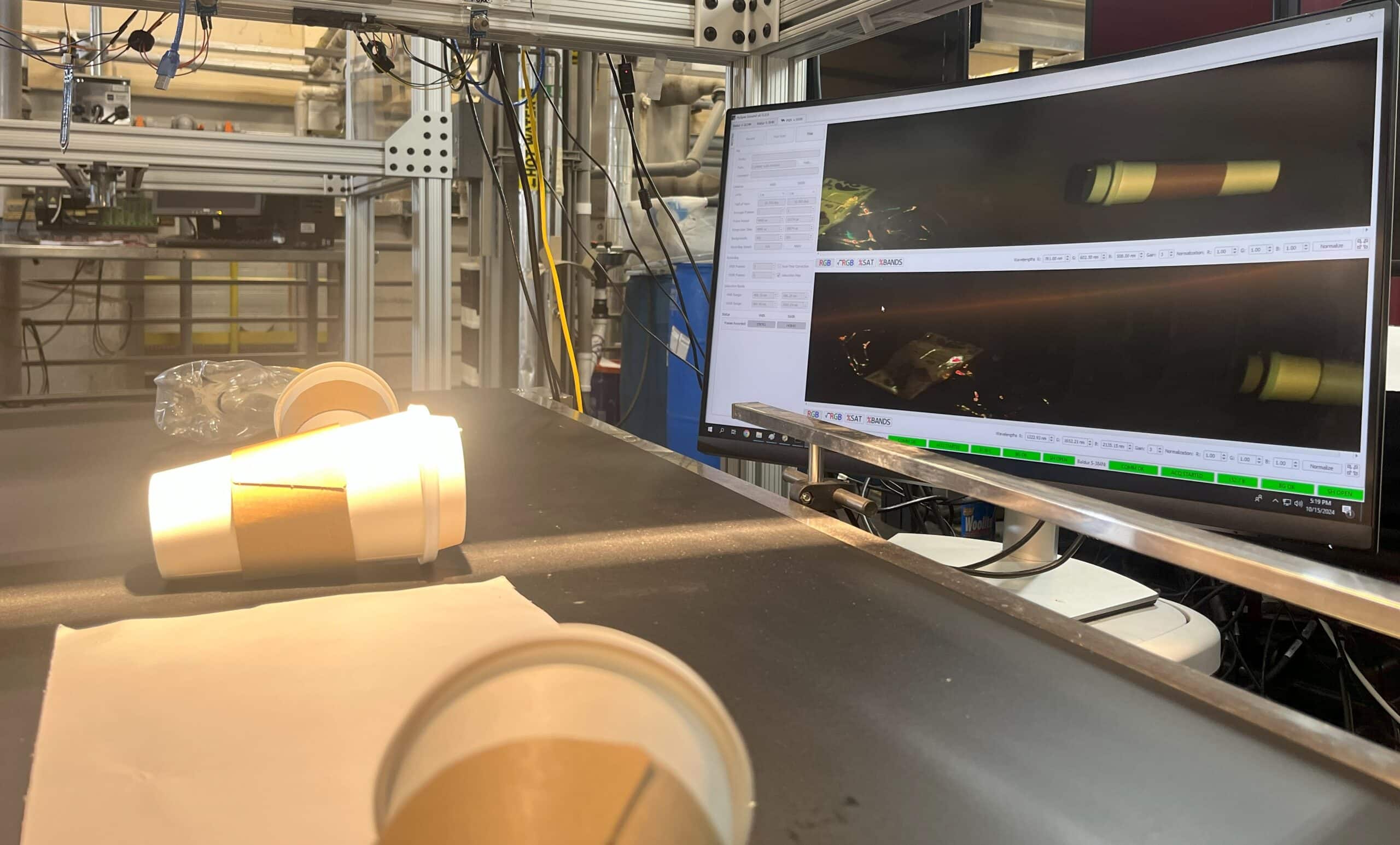
“For example, coffee cups are made from plastic and paper,” said lead author Mariangeles Salas, a Ph.D. student in the Department of Forest Biomaterials at NC State. “Millions of these cups are thrown away each year with less than 1% recycled.
“With hyperspectral imaging, we create what is known as a data cube,” Salas explained. “This is a visual representation which describes a pixel’s unique light reflection characteristics in three dimensions. This allows us to identify subtle differences between materials, such as two types of paper in the same coffee cup. Both contain cellulose, but their chemistry and composition differ, meaning they are better suited for different recycling pathways.”

Researchers intend to put this huge influx of data to broader use by creating one of the largest libraries of visual and hyperspectral images with detailed metadata of municipal solid-waste materials. With over a billion spectral pixels and counting, this open-access repository of data will provide waste managers such as municipalities, materials recovery facilities and researchers with an invaluable tool.
This technology could help speed up and improve the accuracy of automated recycling systems, increasing efficiency and reducing the amount of recyclable material lost to landfills, and support a more sustainable circular economy.
The study, “Hyperspectral imaging for real-time waste materials characterization and recovery using endmember extraction and abundance detection,” is published in Matter. Co-authors include Mariangeles Salas, Simran Singh, Raman Rao, Raghul Thiyagarajan and Lucian Lucia of NC State University; Ashutosh Mittal and John Yarborough of the National Renewable Energy Laboratory; and Anand Singh of IBM.
This work was supported by the U.S. Department of Energy’s Office of Energy Efficiency and Renewable Energy (EERE) under the Bioenergy Technologies Office (BETO) award number DE-EE0009669.
-pitchford-
Note to editors: The abstract of the paper follows.
“Hyperspectral imaging for real-time waste materials characterization and recovery using endmember extraction and abundance detection”
Authors: Mariangeles Salas, Simran Singh, Raman Rao, Raghul Thiyagarajan, Lucian Lucia and Lokendra Pal, NC State University; Ashutosh Mittal, John Yarborough, National Renewable Energy Laboratory; Anand Singh, IBM.
Published: Aug. 1, 2025 in Matter
DOI: 10.1016/j.matt.2025.102365
Abstract: Hyperspectral imaging, combined with advanced spectral unmixing techniques and artificial intelligence, offers a powerful solution for improving material identification and classification. This study evaluates the effectiveness of the pixel purity index and the sequential maximum angle convex cone algorithms in extracting and validating spectral signatures from pure samples of paper components (cellulose and lignin) and plastic (polypropylene). Principal-component analysis showed that both algorithms captured nearly all relevant variance for the tested materials. Spectral signatures were compared using the spectral angle mapper, revealing high similarity in the short-wave infrared region and greater variability in the visible near-infrared range. The methodology was then applied to a disposable coffee cup to detect and quantify mixed materials, accurately estimating material abundance and object area with less than 1% error. This approach enhances material classification, supporting product verification, quality control, and automated sorting for sustainable waste management and resource recovery.


