A Gift That Keeps On Giving
Thanks to more than four decades of research by geneticists in the Department of Forestry and Environmental Resources, North Carolina’s Christmas tree industry is poised to thrive for many future generations. With that comes economic and environmental benefits for all of our state and beyond, no matter which holidays you celebrate.
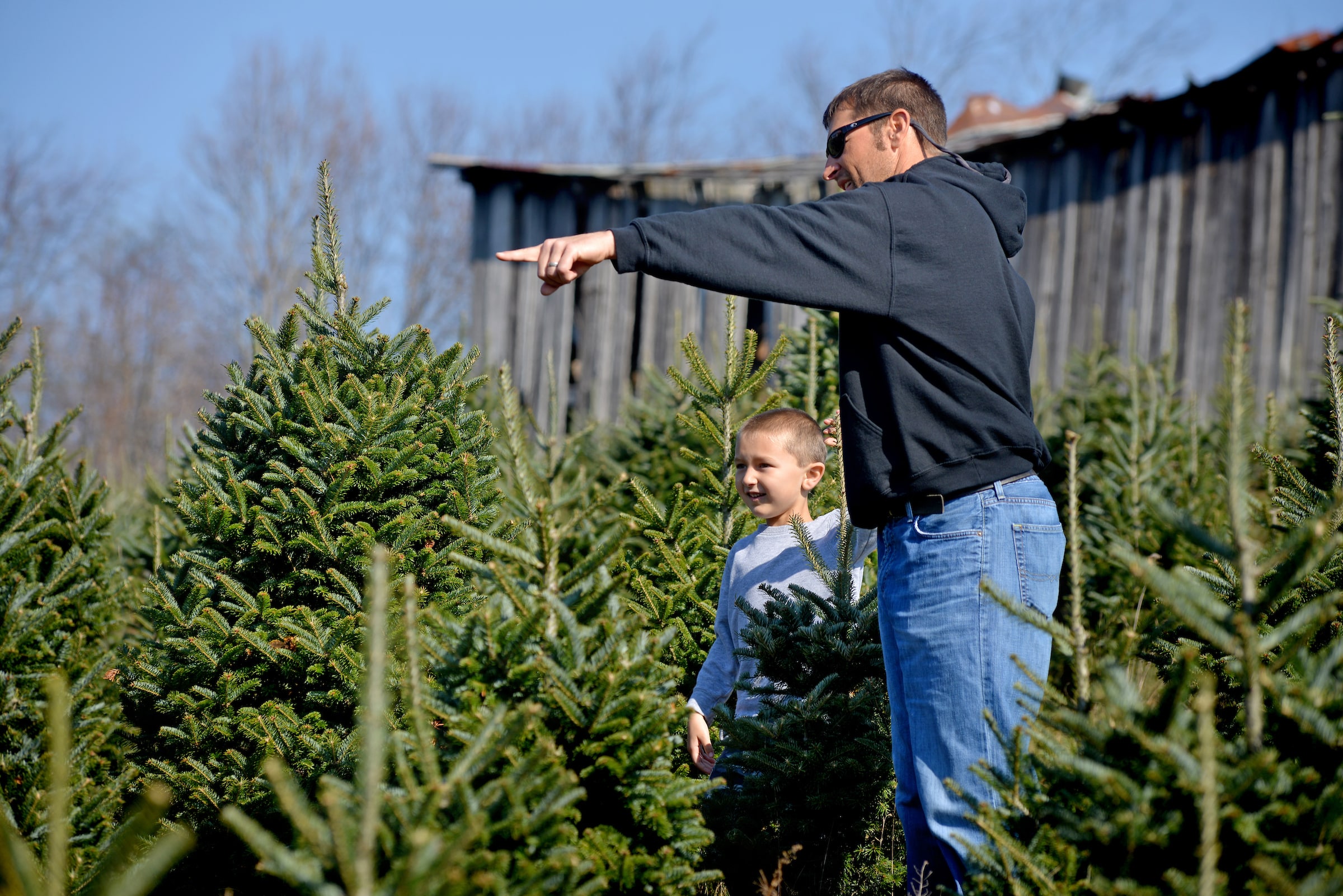
In the United States, putting up Christmas trees began to become a popular tradition around the mid-19th century.
It would take roughly another 100 years, however, for the first now-famous Fraser firs to be commercially grown in the mountains of North Carolina — which today ranks second only to the state of Oregon in annual Christmas tree production nationwide.
“The Christmas tree industry really started to pick up in western North Carolina with the Fraser fir in the 1950s,” says Justin Whitehill, an assistant professor in NC State University’s Department of Forestry and Environmental Resources and leader of the Christmas Tree Genetics Program.
North Carolina Fraser firs fast became a favorite in the southeast, and in the fall of 1971, the prized species earned its first of many selections as the official White House Christmas tree. Throughout the ‘70s, its popularity effectively tripled — as growers harvested nearly 1.5 million Fraser firs in 1979, up from closer to 400,000 in 1972.
A little over four decades later, Fraser firs remain vital to the economic health of North Carolina’s agricultural industry as a whole. For the industry to continue thriving, though, farmers need trees that can grow faster — and survive better in spite of increasingly unpredictable weather patterns and an ever-changing environment.
Thankfully, forest geneticists at NC State have been working to continuously improve Christmas tree attributes for almost as long as they’ve been grown here in North Carolina.
On Nov. 5, at the Upper Mountain Research Station in Ashe County, about a three-hour drive west of Raleigh and closer to 30 minutes from the Virginia border, representatives from our university officially signed an agreement with the North Carolina Department of Agriculture and Consumer Services (NCDA) to license nearly 55 total varieties of two Christmas tree species.
“We have 21 varieties of Virginia pine and 25 varieties of Fraser fir that we’ve licensed to the NCDA,” Whitehill says. “This is the culmination of 40-plus years of combined research and partnership with the NCDA.”
Growing Better Christmas Trees
The new varieties of Fraser fir and Virginia pine have been selectively bred to “grow faster, shorten crop rotations, and yield a higher dollar value at time of harvest than the current industry standard,” according to Whitehill.
Plus, after harvest, the trees are expected to shed very few needles in comparison to the competition. Whitehill says that Fraser fir trees already have better needle retention than any other species on the market, but the varieties selected for their new seed orchard at the Upper Mountain Research Station shouldn’t exceed 2-3%.
To underscore the significance of these scientific advancements — and the new licensing agreement between NC State and the NCDA — the signing was held in conjunction with an annual Christmas tree lighting ceremony that marks the start of the selling season for growers.
NC Commissioner of Agriculture Steve Troxler capped off the signing ceremony with closing remarks.
“It’s always a joy to celebrate our Christmas tree industry, but today is more than just a celebration — it’s a milestone. The ceremonial signing today represents decades of hard work, partnership and perseverance,” Troxler said in his remarks at the ceremonial signing event. “This signing marks the culmination of nearly three decades of research and collaboration between the NC Department of Agriculture and Consumer Services and NC State University’s Christmas Tree Genetics Program.”
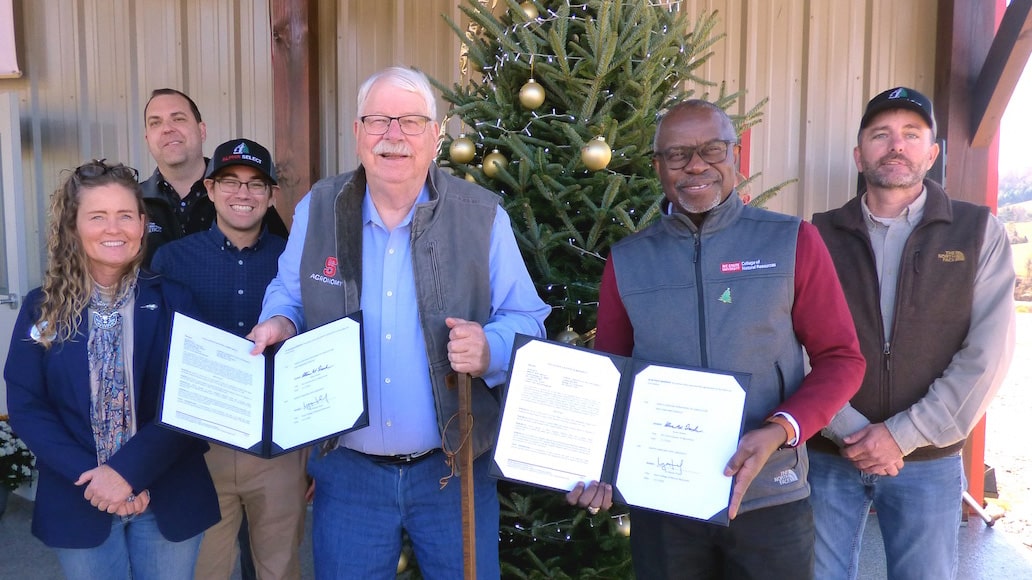
At the outset of this decades-long partnership, the researchers’ goal was “simple but powerful,” Troxler said.
“They wanted to create better trees for growers and better trees for families. Trees that are more uniform, hold their needles longer, resist disease and look beautiful in homes across America,” Troxler said. “That work is paying off today.”
Reaching a Licensing Deal
It took many years of research to reach where the Christmas Tree Genetics Program is today. Tens of thousands of hours working in the lab, planting seeds in the field, then harvesting and analyzing samples.
But to reach the point of a licensing agreement, it also takes plenty of work behind the scenes by NC State’s Office of Research Commercialization. When Whitehill was ready to begin negotiating a deal, he reached out to ORC and was connected with then-Licensing Associate Brian Eller, who’s now interim associate vice chancellor for technology licensing, and Rob Whitehead, ORC’s senior licensing and germplasm agreements associate.
“We worked with Rob Whitehead to get the license agreement hammered out, and Brian was really instrumental in pushing the process forward, making sure that both the NC Department of Agriculture and NC State were comfortable with the terms,” Whitehill recalls. “It was a group effort, and these are conversations that I’ve been having off and on for almost five years with ORC.”
Whitehill also credits Sasha Campbell, ORC’s assistant director of creative services, with designing a custom logo to help brand the new, genetically enhanced lines of Fraser fir and Virginia pine.

“The seeds will be sold under a trademark called Alpha Select. It’s a way to let growers and consumers know about the quality that they’re getting — and also symbolizes the partnership between NC State and the NC Department of Agriculture,” Whitehill says.
Planting the Seed
Under the recently signed agreement, 20% of the licensing revenue will come back to NC State — a portion of which will be reinvested into the Christmas Tree Genetics Program, Whitehill says.
While this landmark licensing agreement is brand-new, our university has partnered with the NCDA to advance the state’s Christmas tree industry since the late ‘90s.
“In 1998, the work began to identify, test and refine the very best Fraser fir genetics,” Troxler said. “Researchers like Dr. John Frampton at NC State and our own Tracy Taylor dedicated their careers to this effort.”
Frampton, a pioneering Christmas tree geneticist and professor emeritus of forestry, established the Christmas Tree Genetics Program in 1996. About a decade later, in a 2006 interview with local media outlet WRAL News, Frampton said that to his knowledge, he was “the only scientist that calls himself a Christmas tree geneticist in the nation.”
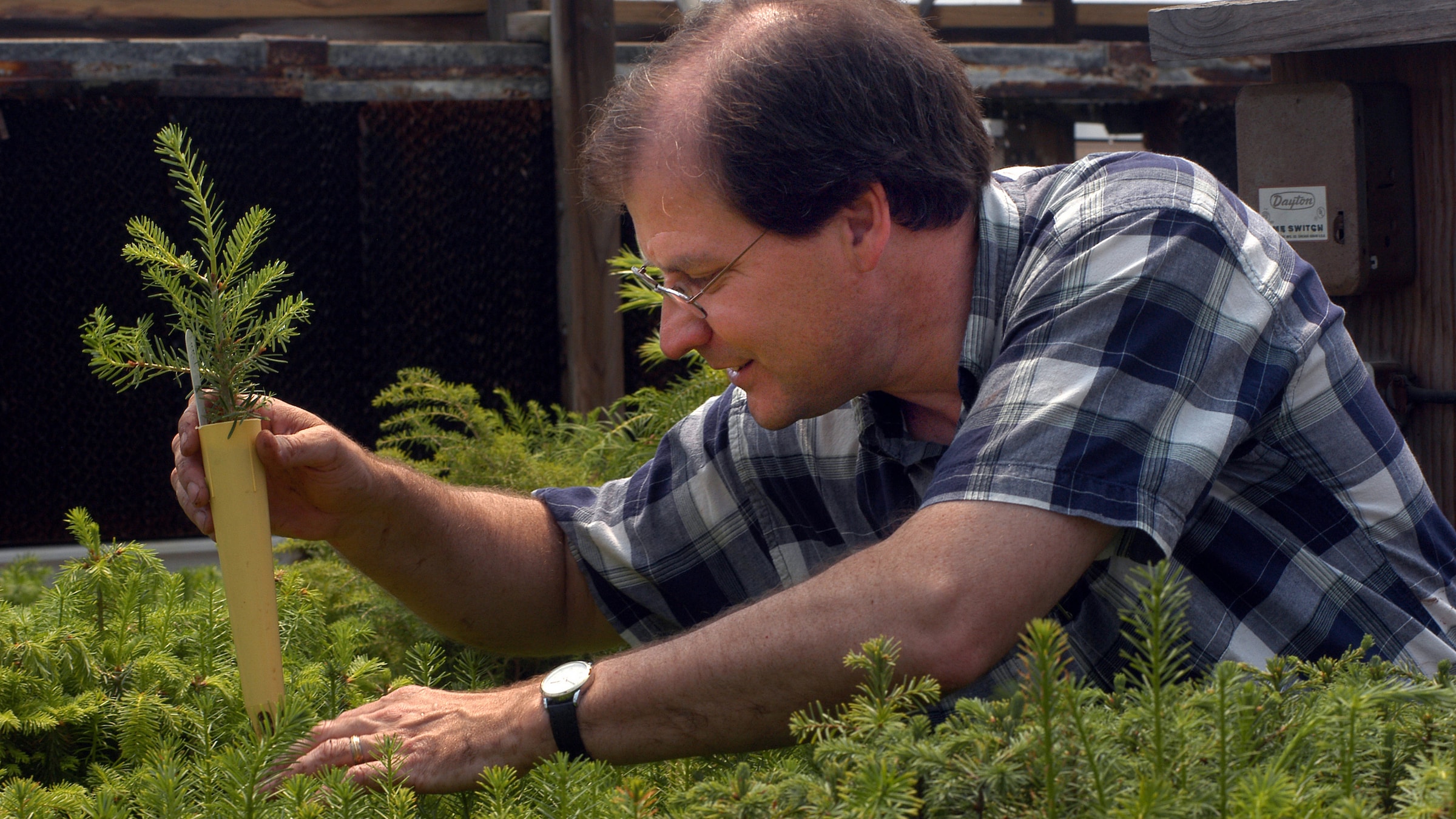
Out of the more than 28,000 trees Frampton collected back in the late ‘90s, he only planted the best few hundred of the bunch. From those 305 trees, Frampton then carefully selected the 25 “best of the best” trees to clip and form the foundation of a seed orchard at the Upper Mountain Research Station.
“That’s less than a tenth of one percent of his original collection, and it shows remarkable care and dedication to the scientific advancement of Fraser firs,” Troxler said.
By spring of next year, the new seed orchard is poised to be the first — and only — source of certified Fraser fir seeds on the planet.
“Seed that has been tested, verified and produced right here in North Carolina will be certified for the world,” Troxler said.
But, most importantly, the seed orchard’s goal is to ensure our state and regional growers have access to improved genetics.
“This will help us keep seed production right here in our state so our farmers have a steady, dependable supply of the best Fraser fir seed in the world,” Troxler said.
The genetically improved Fraser firs at the Upper Mountain Research Station’s new seed orchard were first planted in 2018. Since then, though, the seeds themselves certainly haven’t been the only thing growing.
Looking Ahead to the Future
In 2024, the USDA National Institute of Food and Agriculture’s Specialty Crop Research Initiative awarded NC State and the Christmas Genetics Program a nearly $7.5 million research project. Assembling a team of experts from around the globe, Whitehill recruited collaborators from UC Davis, the University of Connecticut, the University of Florida, Michigan State University, Oregon State University and Washington State University, among others.
“We have five main project objectives, which all center around various aspects of Christmas tree research and extension, to help the industry be ready for the next 20 to 50 years,” Whitehill says.
Long before the first Fraser firs were commercially grown in western North Carolina, the entire state’s agricultural industry thrived on tobacco.
“Tobacco was the lifeblood of these mountain communities for generations, and when it faded, our farmers adapted. Christmas trees became the new economic driver,” Troxler said.
Around the same time Frampton began his work identifying, testing and refining the best genetic attributes of Fraser firs, in the late fall of 1998, four of the nation’s largest cigarette manufacturers reached a settlement with state attorneys general across the country, in which the manufactures agreed to pay more than $200 billion — about $4.5B of which was estimated to be paid to the state of North Carolina.
The NC Tobacco Trust Fund Commission is one of two programs still in existence created by the North Carolina General Assembly in 2000 to distribute those funds. In 2022, the commission granted nearly $385,000 to the Upper Mountain Research Station to build the Tobacco Trust Fund Christmas Tree Seed Center of Excellence, which is set to officially open in spring 2026.
Since being founded in 1887, as the North Carolina College of Agriculture and Mechanic Arts, our university has worked with the state’s agricultural industry to ensure that cutting-edge research discoveries reach the right hands. So it’s only right that we’re continuing to help farmers across North Carolina — no matter the crop they grow — remain at the forefront of innovation.
“These agreements represent the future of our Christmas tree industry,” Troxler said.
Gesturing behind him toward the seed orchard and center in the making, as he began to wrap up his remarks, Troxler said to the audience, “You’re looking at the future of an industry that means more than $250 million to our state’s economy. It also represents countless Christmas memories that are yet to be made for families across the country.”
But it’s not just farmers and families who celebrate Christmas who benefit from trees that grow faster and better resist drought and pests.
“I know not everyone puts up a Christmas tree, but the work that we’re doing aims to produce more trees on less land, and also use less inputs like nitrogen or pesticides,” Whitehill says.
So, no matter how you spend the holidays, NC State and NCDA’s new Alpha Select lines of Fraser fir and Virginia pine should be a gift that keeps on giving — for growers, the environment, and our state and regional economies — for many seasons to come.