Recalling ‘The Students’ Friend’
Susan Colwell Carroll was among the first eight people — and the only woman — hired when the North Carolina College of Agriculture and Mechanic Arts opened in 1889. She is also one of a few people in NC State history to have multiple buildings named in her memory.
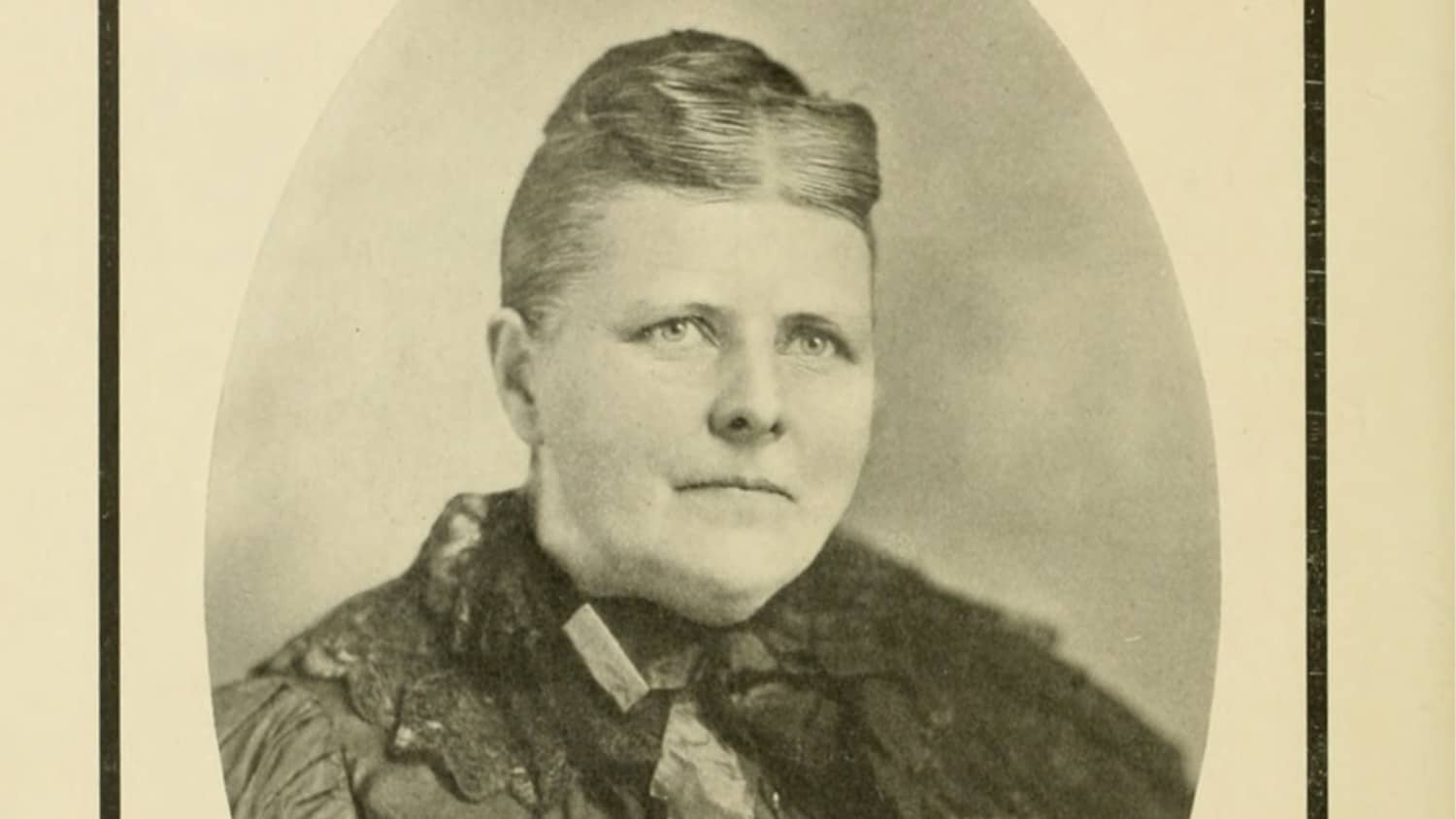
A recently widowed mother of one boarded a short-hop train in the modern-day town of Wallace, North Carolina, bound for Raleigh and a job she had no experience for, with her 10-year-old son and her younger brother in tow.
In late 1889, it was a welcome opportunity for a sturdy and caring woman at a time when many single moms had unrelenting jobs in textile or manufacturing mills, in domestic services or in nursing care.
She was on her way to take a position as the matron of her home state’s new industrial school, the North Carolina College of Agriculture and Mechanic Arts. It’s known today as NC State University, the largest school in the University of North Carolina System, but back then it was a fledgling enterprise with just one building, three pastures, seven faculty and 72 brave students who made up the inaugural class.
All tended to by Susan Colwell Carroll, the new school’s first full-time female employee.
“At a moment’s notice she could tell what room a man was assigned to, who his roommate was; and in the many efforts to confuse and puzzle her she was always triumphant; and then how she would laugh at the crestfallen boy who had attempted to prove that ‘Mrs. Carroll sometimes makes mistakes.’”
When she first arrived — hired on the same day as the first five of the new school’s faculty and three days before founding president Alexander Q. Holladay — she served as the school’s matron, caring for students in the cadet hospital and overseeing order in the living spaces on the top floor of Holladay Hall and, later on, the freestanding dormitories that followed.
She was a mother figure, disciplinarian and full-time friend to all of the school’s earliest students. She recalled on sight the name of every one enrolled during her 12 years of service and could beat almost every one of them in recalling facts of importance.
“Her memory for names and faces was wonderful,” wrote an unidentified writer in the inaugural edition of the Agromeck in 1903. “At a moment’s notice she could tell what room a man was assigned to, who his roommate was; and in the many efforts to confuse and puzzle her she was always triumphant; and then how she would laugh at the crestfallen boy who had attempted to prove that ‘Mrs. Carroll sometimes makes mistakes.’”
Why, though, did a group of college-age men need a mother figure to live with them? Isn’t one of the main lessons of going to college independent living?
The fact is, many of the first students enrolled at NC A&M were as young as 14 years old and had not yet taken college preparatory classes in mathematics, English and sciences, which is why the first class in 1890 had 72 enrollees and the first graduating class in 1893 conferred just 19 degrees. They specifically enrolled to take high school-level classes needed to take college courses.
“Many a homesick lad, away from home and friends for the first time, ready to give up, wept out his misery on her shoulder, and, being comforted and strengthened by her words, buckled on his armor again and fought the battle out,” wrote the Agromeck.
In 1897, two students died in the infirmary of unrelated illnesses they contracted before returning to campus. She was there to comfort them in their final moments.
“To those who came under her administration in the hospital she was patient and untiring, sitting up night after night,” the tribute continued. “She encouraged the weak, and when the end came the dying boy clung to the hand that had nursed him and listened to the kindly voice that bade him put his trust in God.”
‘The Right Woman in the Right Place’
The position of a resident adult carried over for well more than three quarters of a century in residence halls and both fraternity and sorority houses. Carroll was not the only woman on campus in the earliest days. Not long after Carroll was elected matron, another woman, Ellen Buffaloe McGuire, was hired to be a part-time worker in the dining hall of Holladay Hall, becoming the school’s first female African American employee. Born into slavery in northern Wake County in 1860, McGuire eventually became a full-time employee who spent 50 years on campus, the last 31 in the same infirmary where Carroll worked.
Carroll raised her son, John William Carroll, on the grounds of A&M College. When he had finished preparatory classes, he enrolled in the agriculture program, graduated with a Bachelor of Science degree in 1897 and eventually pursued a medical degree at the Virginia Medical College and the Maryland Medical College, determined to follow his mother’s footsteps in the health care profession.
One evening in the late summer of 1901, John was called home to Raleigh after his mother fell ill in her college residence. He was here in time to care for her for several days, but on the evening of Sept. 6, 1901, as he was retrieving her a glass of water, Susan Carroll died of what was determined to be cardiac arrest.
“She was not only an esteemed and beloved friend of this class, but a worthy friend of the entire student body; she was one of those sweet and noble women whom none knew but to love; whom none named but to praise.”
“She was loved by every boy who had ever attended the college,” wrote Raleigh’s News & Observer.
Many around the state and beyond its borders mourned the loss of one of the college’s most dedicated employees.
“She was not only an esteemed and beloved friend of this class, but a worthy friend of the entire student body; she was one of those sweet and noble women whom none knew but to love; whom none named but to praise,” wrote the 1903 class historian in the Agromeck. “Rugged in person, in health and in character, blunt in speech, kindly of heart to the extreme, impressive and commanding, she was the right woman in the right place.
“Her heart was big, her sympathy unbounded.”
Students went to work to raise money to memorialize Carroll, collecting more than $165 that was used to erect a headstone and a marble plaque at the entrance of the school’s first infirmary (now Winslow Hall). They raised so much money on her behalf they were able to set up “The Carroll Fund” to benefit students in need.
In 1928, under the administration of Eugene Clyde Brooks, a resolution was passed by the Board of Trustees to change the name of the Cadet Infirmary to the Carroll Hospital, making it the first building on campus named in honor of a woman.

That name was eventually changed to Alumni Hall after a massive renovation in 1959 to honor the more than 300 students and alumni who died during World War II and the Korean War. The name was again changed in 2006 to Winslow Hall for an original member of the founding Watauga Club when the Roy and Dorothy Park Alumni Center opened on Centennial Campus.
When Central Campus expanded in the 1960s in a $17 million building boom, three similar dormitories were proposed near the southern entrance of the Free Expression Tunnel. Before ground was even broken, Chancellor John Caldwell designated that the tower nearest the tunnel would bear the name of Susan Carroll. It was dedicated as the first dormitory built specifically for female students in 1968. (Watauga Hall was a temporary women’s dormitory from 1965 to 1968 while the tri-towers of Carroll, Bowen and Metcalf were under construction.)

Carroll is one of just four people who have had multiple buildings named in her honor, the others being original benefactor Richard Stanhope Pullen, who gave the state of North Carolina its original 62 acres in 1865 to create an industrial school; Edward S. King, the secretary of the campus Young Men’s Christian Association; and Jane S. McKimmon, the school’s first female undergraduate and well-known Extension agent.
When Carroll died in 1901, her remains were taken back to her hometown in Duplin County, escorted by some of the best-known names in school history: future school presidents D.H. Hill Jr. and Wallace Carl Riddick and Watauga Club members Charles Park and E.B. Owens. Among the handful of students who also escorted her body home were future North Carolina governor O. Max Gardner and future textile executive C.D. Welch, namesake of NC State’s only all-female residence hall today.
A Legacy Lives On
Long before women’s suffrage or the equal rights movement, Carroll’s archaic role as matron was essential in the earliest days of the institution. Her legacy thrives in the memory of her son, a longtime contributor to his alma mater who went on to be a physician in both Sampson County and the town of Russellville, South Carolina, providing health care to both rural communities.
And her grandson, John William Carroll Jr., went to dental school and served as one of two dentists in Wichita Falls, Texas, from the 1920s until after World War II.

Her legacy on campus should also be celebrated, as students at the turn of the 20th century hoped when they raised money in her memory.
“Future classes will remember Mrs. Carroll in name only,” wrote the student newspaper The Red & White in January 1902, “but those who were here during the years of her kindly ministrations will never forget the motherly face and watchful care of the one who spent the best years of her life that they might live.”
In Campus Characters, we highlight and celebrate the men and women who have helped add a certain spice and personality to NC State. If you’d like to suggest someone to profile as a Campus Character, email Tim Peeler at tmpeeler@ncsu.edu.
- Categories: