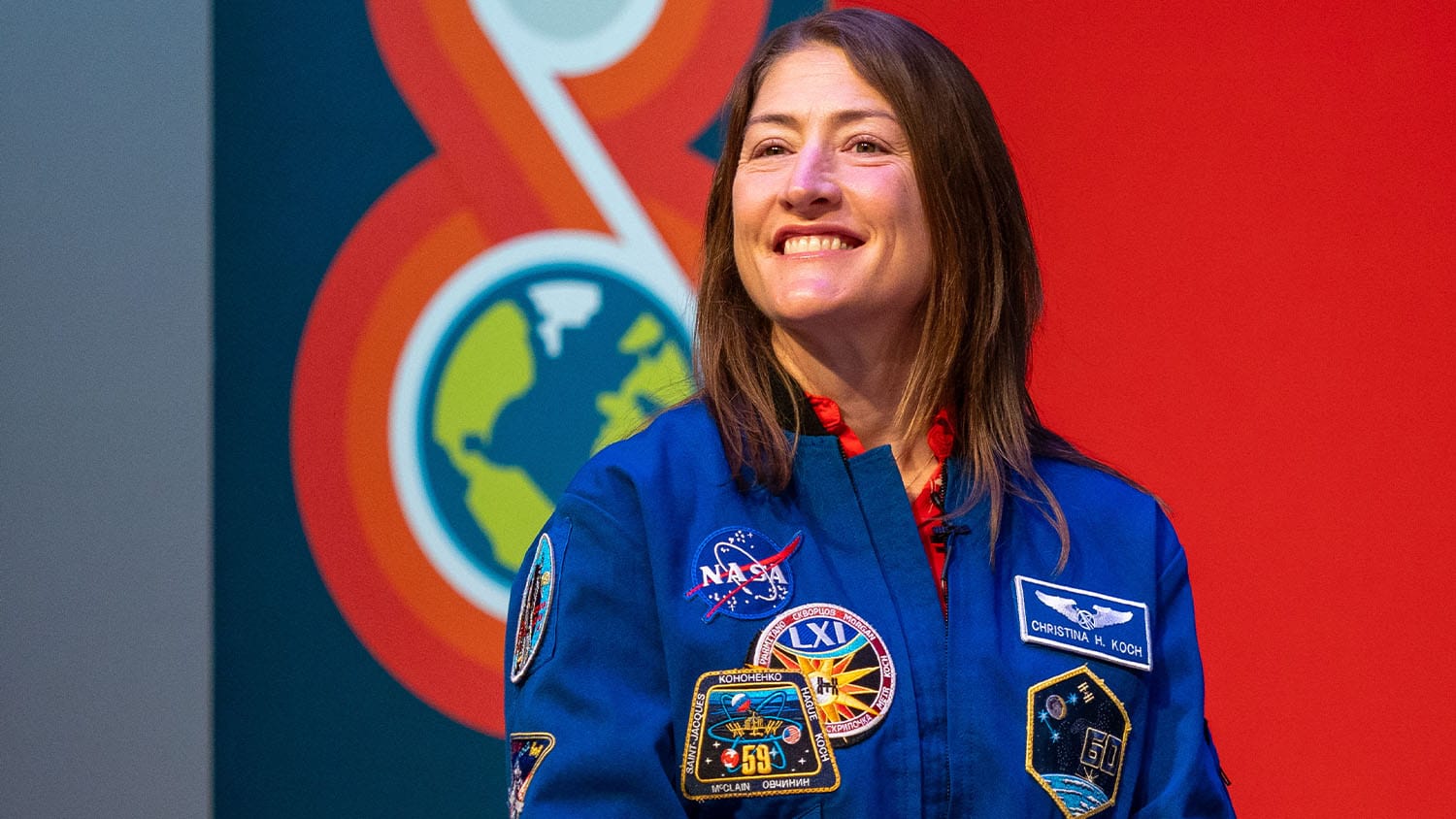
Koch Eager for Splashdown
Three-time NC State graduate and Artemis II astronaut Christina Koch and the other three members of the crew are headed back to Earth following NASA’s first return to the moon in more than 50 years.

And now, she’s heading home.
Sometime Friday around 8 p.m. Eastern, if all goes as planned, three-time NC State graduate and Artemis II astronaut Christina Koch and her three crewmates will splash down in the Pacific Ocean just off the coast of San Diego to end the farthest human flight in history.
It’s been quite a ride. They’ve been to the far side of the moon, where they saw details never before witnessed by the human eye. They named two previously anonymous craters.
They’ve taken thousands of spectacular, high-definition photos with the 100 or so handheld and mounted Nikon D5 and Z9 cameras they brought with them. For Koch, it was a skill first developed when she was a staff photographer for NC State student newspaper Technician.

They ran into a little trouble on the day after launch, when one of the three toilets onboard their Orion spacecraft malfunctioned. Koch, a mission specialist and trained electrical engineer, stepped up to fix the $23 million balky device and proudly claimed the title “space plumber.”
Normally reserved and used to being in the most remote places on Earth and in space, Koch has been in the spotlight throughout the lunar flyby mission, even going viral for a photograph of her sculpted rock-climber’s forearm and biceps, posted by the Goddard Space Flight Center.
It was an unexpected glow-up for a serious astronaut used to utilizing her electrical engineering and physics backgrounds to complete complicated experiments, as she did on her 328.5 days on the International Space Station some six years ago.

It comes with the territory, of course, since every moment on the trip has been broadcast via NASA’s YouTube channel. The outcome has been the biggest revival in attention to space exploration since the last Apollo mission landed on the moon.
She caught the attention of Hollywood star Jessica Alba for requesting the brand of hand lotion sold by Alba’s company. It wasn’t the only unintentional product placement on the mission: As the spaceship neared its farthest distance from Earth, a plastic jar of the chocolate-hazelnut spread Nutella floated through Koch’s flailing hair and around the cabin.
The 47-year-old mission specialist spoke the crew’s first words after reemerging from a 40-minute communications blackout as they traversed around the far side of the moon.
“It is so great to hear from Earth again,” she said. “We will explore. We will build. We will build ships. We will visit again. We will construct science outposts. We will drive rovers. We will do radio astronomy. We will found companies. We will bolster industry. We will inspire, but ultimately, we will always choose Earth.
“We will always choose each other.”

Wednesday night, just before they did a 20-minute space media conference, the astronauts were packing up the cabin to prepare for the most dangerous part of the mission: landing on Earth.
They will hurtle back into the planet’s atmosphere at 30 times the speed of sound, creating a friction temperature of more than 5,000 degrees Fahrenheit as they reenter the atmosphere to be greeted by the awaiting arms of a U.S. Navy crew for transport to the U.S.S. John P. Murtha.
As the mission — which began three years ago with constant training and preparation — comes to an end, Koch reflected on the journey in the cramped space camper, its 330-cubic-square-foot enclosure and what she might miss after all the time she spent with fellow crew members Victor Glover, Reid Wiseman and Jeremy Hansen.
“I will miss the camaraderie,” Koch said. “I will miss being this close with this many people and having a common purpose, a common mission, getting to work on it hard every day, across hundreds of thousands of miles with a team on the ground.”
“We will always choose Earth.”
It’s all part of being a space explorer, bringing back their description of previously unseen parts of the universe, how they survived and what the next steps will be in returning humans to the moon and, ultimately, going on to Mars.
“This sense of teamwork is something that you don’t usually get as an adult,” Koch said. “We are close like brothers and sisters, 100%, and that is a privilege we will never have again. I have to say, I don’t think there’s anything I would say I won’t miss or that I’m just ready to be over, because this whole thing is a package. We can’t explore deeper unless we are doing a few things that are inconvenient. Unless we’re making a few sacrifices, unless we’re taking a few risks.
“Those things are all worth it.”