Bigger Than a Mountain, With a Spirit of Kindness
Former NCAA wrestling champion Tab Thacker’s presence on campus was massive, like the Belltower.
Note: This story was originally posted on GoPack.com in 2007, shortly after the four-time Atlantic Coast Conference champion died at the age of 45.
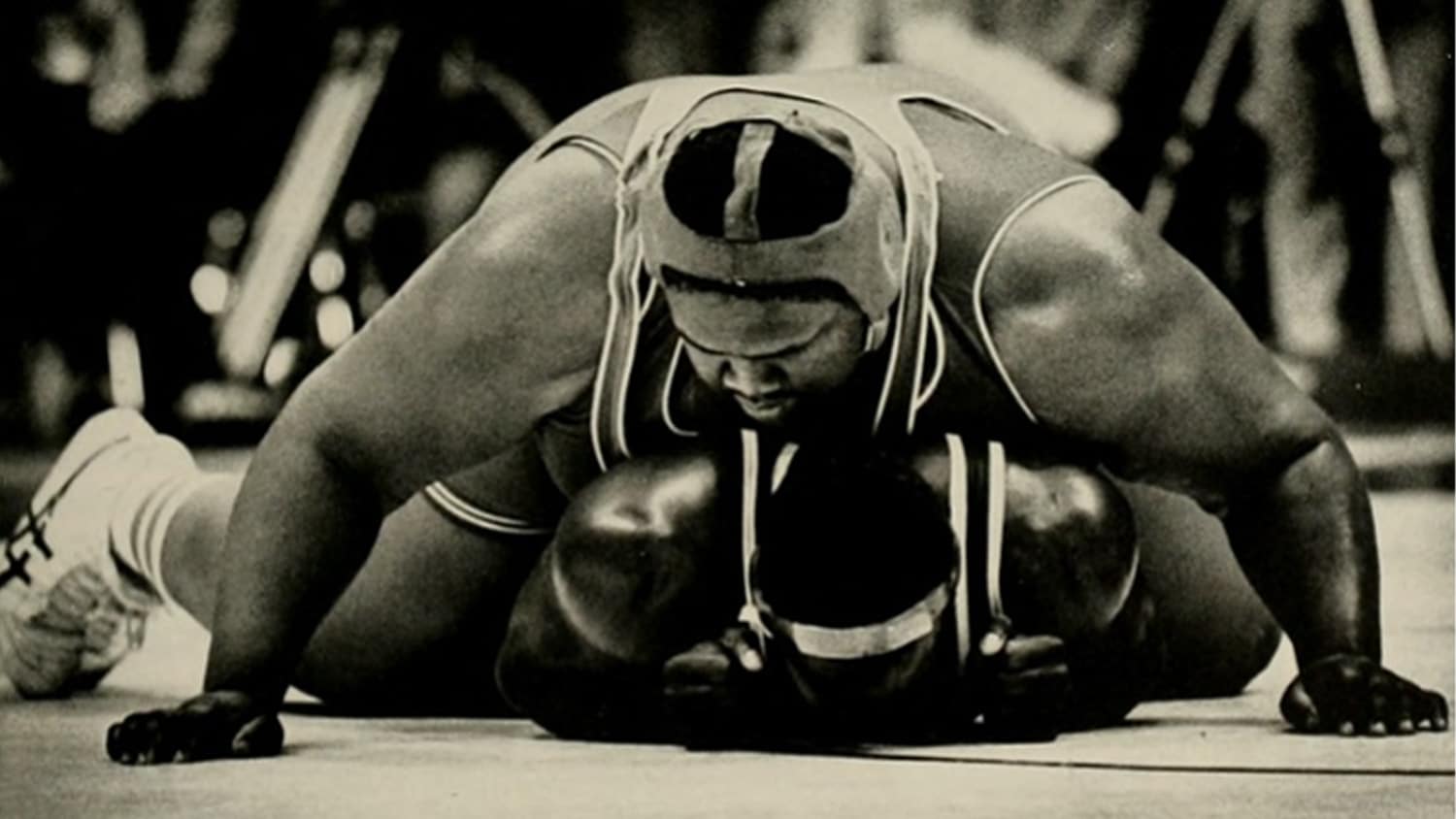
It was often hard to know what to feel sorrier for: the opponents who had to step onto the mat to face massive NC State heavyweight wrestler Tab Thacker, or that tiny moped he rode back and forth from the College Inn on Western Boulevard to his classes every day, especially when pint-sized roommate Vince Bynum was riding on the handlebars.
Let’s go with the moped, since it never had the chance to avoid facing Thacker with a forfeit, as many opposing heavyweights of his day often did.
Whether on the mats, in the movies or on campus, Talmadge Lane Thacker was a unique character in the history of NC State’s campus, right up to the day he died on Dec. 27, 2007, at the age of 45.
A Himalayan mountain of a man, the 1984 NCAA heavyweight champion stood 6-foot-5 and weighed roughly 450 pounds. “Roughly” is the correct word because there were only a couple of places in the country where Thacker could weigh in, and he usually just waited until the NCAA wrestling championships every year to step on the scales.

As a junior, Thacker weighed in at 410 pounds. He worked hard on getting in condition for his senior year, because he was so driven to win a national championship. He was disappointed at having finished eighth as a freshman and sixth as a sophomore and a junior. So he toned himself up, turning his ham-sized arms into muscle. Many of his friends commented on how (relatively) slim he looked. He figured after sweeping through the regular season undefeated and winning his fourth consecutive ACC heavyweight title, he had shed at least 30 pounds or more.
He was more than a little shocked when he stepped on the scales just prior to the 1984 NCAA Championships in East Rutherford, New Jersey, and saw the needle jump all the way to 447½ pounds.
“Surprised?” Thacker said. “Oh, yeah. I had been feeling a little thin.”
It didn’t matter, of course. The NCAA had no weight limitation for heavyweight wrestlers. After seeing Thacker — who never lost a match to an ACC opponent — early in his career, the NCAA immediately imposed a 275-pound limit for heavyweights ostensibly for safety reasons. (The current limit for heavyweights is 285 pounds.) NC State wrestling coach Bob Guzzo petitioned for a change on Thacker’s behalf because he would have been ineligible to compete.
The NCAA eventually exempted Thacker and all other contemporaries who had already entered school from abiding by that limit, which allowed Thacker to fulfill his dream of winning a national title. He completed his senior season at a perfect 31-0 and became the second individual wrestling champion in school history, winning the title on his 22nd birthday by beating Nebraska’s 300-pounder Gary Albright.
‘A 400-Pound Body and a 500-Pound Heart’
To think of Thacker as simply a wrestler is to miss the point entirely. In the early 1980s, he was an NC State icon, as recognizable — and nearly as prominent — as the Belltower.
“I have a 400-pound body and a 500-pound heart,” Thacker said with great pride.
Every athlete on campus knew where to find Thacker’s room at the College Inn. He was always there, smiling and sharing snacks. (The standing rule was: Bring whatever you like to Tab’s and Vince’s room, eat as much as you like — and Tab gets all the leftovers.) Along with the chips, cookies and quarts of milk, he dispensed advice, warning his fellow athletes to stay away from bad situations, drugs, alcohol and all the other vices that could lead them astray.
For a guy who could crush just about anyone who ever looked at him the wrong way, Thacker had a sweet demeanor.
“I’m a big guy trying to fit in,” Thacker once said. “I’m not big-headed and I don’t try to intimidate anybody [off the mat]. I’m just trying to be average. People say to me, ‘if I was as big as you, I’d beat everybody up.’ I tell them if you beat everybody up, you won’t have any friends and nobody to care for you.”
He had friends by the dozens back then, and by the hundreds in his final years, his heart still spreading its message of friendship and love.
“I’m a big guy trying to fit in. I’m not big-headed and I don’t try to intimidate anybody [off the mat].”
“His door was always open to everyone,” said former NC State track All-American Gus Young, who eulogized Thacker at his funeral. “And he always told you what he thought.”
Young will never forget Thacker’s kindness. As a freshman, Young was lonely. A native of Jamaica who moved to New York with his father at the age of 12, Young came from a family of modest means and couldn’t go home for Christmas.
“Come home with me,” Thacker said. “There’s always room for another plate at the table.”
That might be debated in some circles: Tab’s father, Jimmy, weighed 280 pounds. His mother, Mary, weighed 225. His little brothers, Tray and Trel, both topped 250. But they made room for Young and treated him like family.
“I barely knew him at the time,” said Young, a member of NC State’s track and field 4X100 team that won the 1985 NCAA Championship, a little over a year after Thacker won his heavyweight title. “But he opened up his heart and his home. I was treated just like I was a brother or a son.”
Thacker was the best man at Young’s wedding and a frequent recipient of his phone calls, no matter where in the world Young, a first sergeant in the U.S. military police, was serving.
From Raleigh to Hollywood
Obviously, Thacker’s size was intimidating. The first time Clemson football player William Perry saw him, “The Fridge” said: “Man, you make me look small.” Burt Reynolds and Clint Eastwood, who gave Thacker his start in the movies, called him “Condo” while he was on the set of City Heat, in which he had a small part as a bar bouncer, because he was more substantial than an apartment. Thacker also had minor roles in two Police Academy sequels and the football-focused movie Wildcats.
The thing is, Thacker didn’t become a national champion because of his size. There were other big wrestlers on the scene back then not as successful as Thacker, who finished his career with an 84-13-1 record, including his perfect senior season.
“People thought he won because he was so big, he just laid on people,” said Guzzo, the retired Wolfpack wrestling coach. “That’s not true. Tab worked hard. He didn’t have great wrestling skills when he got here — he never even won a high school state championship — but he had the drive to develop his technique and make himself into a champion.
“And for a man that big, he was very nimble on his feet.”
The native of Winston-Salem was quick enough to win a citywide pingpong tournament in Winston-Salem while in the seventh grade and continued to take on all comers through college. He played defensive line for West Forsyth High School’s football team and considered playing nose guard for Wolfpack head football coach Tom Reed after his collegiate wrestling career was over.
But his main athletic passion was basketball. He had a sweet outside jumper. While at West Forsyth, back before he topped 350 pounds, Thacker could dunk a basketball.
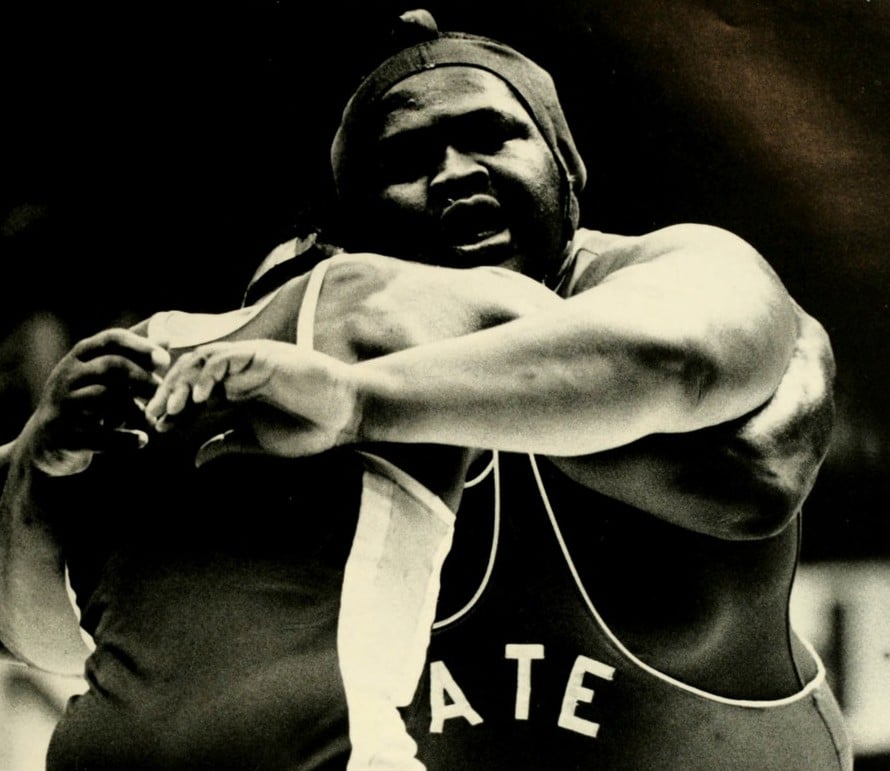
Even at NC State, when he weighed nearly a quarter ton, he could still tap the rim from a three-step start. But who would guard him?
“I didn’t play against him,” said former NC State men’s basketball coach Sidney Lowe, a Thacker contemporary. “And wouldn’t.”
Lorenzo Charles, Ernie Myers and Cozell McQueen did, and while none of those guys backed away from the likes of Ralph Sampson, Hakeem Olajuwon or Jon Koncak, they were smart enough to step aside when they saw Thacker barreling down at them in a pickup game at Carmichael Gymnasium.
“If he started coming down the lane, nobody stood in there to take a charge,” Myers said.
There was only one bitterness in Thacker’s athletics career: his failure to make the 1984 U.S. Olympic team. He always believed that politics, not his injury-hampered showings at the freestyle and Greco-Roman trials, kept him from representing the United States at the Los Angeles Games.
He experienced the Olympics vicariously through Young, who was a member of the 1984 Jamaican track and field team that won a silver medal in the 4×100 relay.
Instead of L.A., Thacker went to Hollywood, rubbing bellies with the likes of Eastwood, Reynolds and Goldie Hawn. He enjoyed the spotlight, but his roots were in North Carolina. And, as anybody who ever wrestled him knew, Thacker was hard to uproot.
He returned to Raleigh, where he ran several popular nightclubs and eventually used his NC State criminal justice degree to open his own company, Heavyweight Bail Bonds.
In his later years, diabetes pinned Thacker. Three years before he died, he lost a foot to the disease. Less than a year later, his right leg had to be amputated. In June 2007, he lost his other leg.
Friends and family — all those people who had counted on Thacker for so many things over the years — helped keep his spirits up over the final months, but his condition worsened.
At his funeral at Raleigh’s Springfield Baptist Church, Rev. Daniel Sanders captured Thacker’s gentle spirit, his struggles with illness and his giving spirit, as did the people who shared in the celebration of his life.
They emphasized what everyone who ever spent enough time with Thacker quickly learned: No matter what, the gentle mammoth always made you feel like you were the biggest person in the room.
In Campus Characters, we explore some of the people who, through the years, have given NC State’s campus a different spice and flair. If you’d like to suggest someone to profile, email Tim Peeler at tmpeeler@ncsu.edu.
- Categories:


