
Tracey Peake

Mar 14, 2013

Researchers Create Nanoscale Spinning Magnetic Droplets

Researchers have successfully created a magnetic soliton – a nano-sized, spinning droplet that was first theorized 35 years ago. These solitons have implications for the creation of magnetic, spin-based computers. Solitons are waves, localized in space, that preserve their size and momentum. They were first observed in water. Solitons composed of light have proved useful… 

Mar 13, 2013

Foundations of Carbon-Based Life Leave Little Room for Error

  Life as we know it is based upon the elements of carbon and oxygen. Now a team of physicists, including one from North Carolina State University, is looking at the conditions necessary to the formation of those two elements in the universe. They’ve found that when it comes to supporting life, the universe leaves… 

Feb 28, 2013

New Species of Plant-Eating Dino Was Lunch for Prehistoric Crocs

Sometimes, the fossil record gives us some really exciting insights into prehistoric life – including grisly details of prehistoric death. Paleontologists have found evidence not only of a new species of herbivorous, or plant-eating, dinosaur, but also that these dinosaurs were preyed upon by the prehistoric forebears of crocodiles. Seventy-five million years ago, southern Utah… 

Feb 21, 2013

Researchers ‘Nanoweld’ by Applying Light to Aligned Nanorods in Solid Materials

Researchers from North Carolina State University have developed a way to melt or “weld” specific portions of polymers by embedding aligned nanoparticles within the materials. Their technique, which melts fibers along a chosen direction within a material, may lead to stronger, more resilient nanofibers and materials. Physicists Jason Bochinski and Laura Clarke, with materials scientist… 

Feb 21, 2013

Talkin’ ‘Bout Regeneration

Incontinence. It’s one of those embarrassing topics we try to ignore, alluding to it only via delicately worded Depends commercials or drug advertisements featuring people made entirely out of plumbing. But it is a problem, and not just for people. In fact, urinary incontinence is an issue in almost 20 percent of spayed female dogs,… 

Feb 15, 2013

Force is the Key to Granular State-Shifting

Ever wonder why sand can both run through an hourglass like a liquid and be solid enough to support buildings? It’s because granular materials – like sand or dirt – can change their behavior, or state. Researchers from North Carolina State University have found that the forces individual grains exert on one another are what… 

Jan 31, 2013

Researchers Find Evidence of Geological ‘Facelift’ in the Appalachians

How does a mountain range maintain its youthful, rugged appearance after 200 million years without tectonic activity? Try a geological facelift – courtesy of the earth’s mantle. Researchers from North Carolina State University noticed that a portion of the Appalachian Mountains in western North Carolina near the Cullasaja River basin was topographically quite different from… 

Jan 23, 2013

Cross Trainers

In the future, biologists and mathematicians will work together to model disease growth. In the present, NC State students are already doing it. 

Jan 16, 2013

Nifty Image of the Day – Neurons!

Troy Ghashghaei, assistant professor in NC State’s Department of Molecular Biomedical Sciences and researcher in the Center for Comparative Medicine and Translational Research, wanted to know more about the function of Sp2, a cell cycle regulator that helps control how cells divide. Using genetic tools, Ghashghaei’s team got rid of Sp2 in certain neural stem cells in… 

Jan 14, 2013

Lack of Protein Sp2 Disrupts Neuron Creation in Brain
A protein known as Sp2 is key to the proper creation of neurons from stem cells, according to researchers at North Carolina State University. Understanding how this protein works could enable scientists to “program” stem cells for regeneration, which has implications for neural therapies. Troy Ghashghaei and Jon Horowitz, both faculty in NC State’s Department of… 

Erlikosaurus

Dec 19, 2012

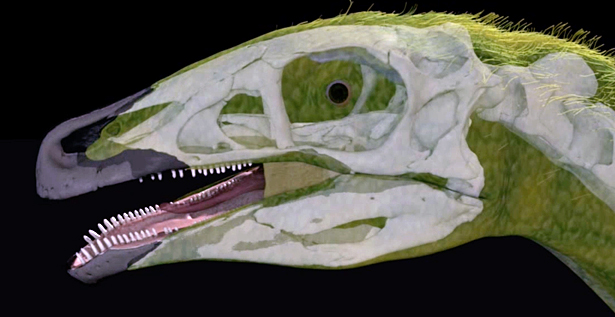
Visualize This: Inside a Dinosaur’s Brain

Want to know how well a dinosaur could see, hear and smell? Get inside its head! That’s what a group of researchers from the U.K. and U.S. did when they recreated the brain of a therizinosaur called Erlikosaurus andrewsi – a 10-foot-long feathered theropod that lived in what is now Mongolia during the Cretaceous period,… 

Dec 11, 2012

5 Questions With Canopy Meg

Meg Lowman is the director of the Nature Research Center at the NC Museum of Natural Sciences and a research professor at NC State. She has conquered the canopy of the rainforest, and opened up an entirely new world to scientific discovery. She’s just published a textbook that will help future generations of canopy scientists get… 

Dec 10, 2012

Researchers Reveal Structure of Carbon’s ‘Hoyle State’

A North Carolina State University researcher has taken a “snapshot” of the way particles combine to form carbon-12, the element that makes all life on Earth possible.  And the picture looks like a bent arm. Carbon-12 can only exist when three alpha particles, or helium-4 nuclei, combine in a very specific way. This combination is… 

Dec 5, 2012

NC State Tips for Holiday Pet Safety

Winter holidays make the final months of the year special. Ensuring the season is enjoyable for the entire family means keeping your pet’s needs in mind, says Dr. Steve Marks, a clinical associate professor and critical care expert at North Carolina State University’s College of Veterinary Medicine. “Like young children, pets can become excitable over… 

Nov 30, 2012

Making Sports Rankings Count

Ever wondered how those sports team rankings get done? Dr. Carl Meyer is a mathematician working on making those rankings more accurate. This video from Inside Science explains how it’s done. Hint: linear algebra is involved.