NC State Experts Can Discuss Phosphorus, Executive Order

A new executive order created to ensure “an adequate supply of elemental phosphorus and glyphosate-based herbicides” for the United States was posted on Feb. 18. North Carolina State University experts can discuss the science and technology involved in the use of phosphorus, as well as policy, economic and sustainability issues related to this essential element.

Jacob Jones, professor in the College of Engineering, directs the Science and Technologies for Phosphorus Sustainability (STEPS) Center at NC State, the world’s largest research center on phosphorus sustainability. Jones works to integrate many research disciplines and sectors to address challenges around phosphorus sourcing, use efficiency, recovery and reuse, and fate. His technical expertise is in materials science and engineering, including mineralogy, crystallography, inorganic chemistry, and nanotechnology.
Jones can be reached at jacobjones@ncsu.edu.

Jay Rickabaugh, assistant professor of public administration, studies how phosphorus policy is developed and implemented at the federal, state and local level in areas such as agriculture, environmental protection and international trade. He recently published a piece examining the challenges public administrators face when collaborating across levels of government and agencies using phosphorus governance as a case study.
Rickabaugh can be reached at jarickab@ncsu.edu.

Justin Baker is an associate professor in NC State’s College of Natural Resources and a research lead for the STEPS Center. As a natural resource economist, Baker focuses on local- to global-scale economic modeling of agriculture, forestry, and fertilizer systems, including international trade dynamics.
Baker can be reached at jsbaker4@ncsu.edu.
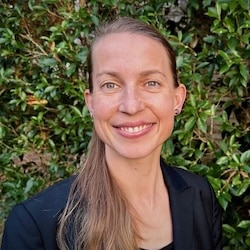
Khara Grieger, assistant professor of applied ecology, works to understand the environmental and societal impacts of new and emerging technologies, particularly those in food and agriculture systems, and best practices for extending and translating complex knowledge to diverse stakeholders in order to inform decisions. She also co-leads STEPS Knowledge Transfer efforts, where she leverages her work in stakeholder engagement to communicate and translate academic research to diverse audiences. She works together with STEPS researchers and diverse stakeholders to share knowledge and experiences, understand stakeholder needs and preferences, and co-create ideas and solutions related to technical and management solutions to phosphorus sustainability.
Grieger can be reached at kdgriege@ncsu.edu.
- Categories: