
Matt Shipman

Jul 28, 2014

Motivation May Explain Disconnect Between Cognitive Testing and Real-Life Functioning for Older Adults

A psychology researcher at North Carolina State University is proposing a new theory to explain why older adults show declining cognitive ability with age, but don’t necessarily show declines in the workplace or daily life. One key appears to be how motivated older adults are to maintain focus on cognitive tasks. 

Jul 28, 2014

Social Network Research May Boost Prairie Dog Conservation Efforts

Researchers using statistical tools to map social connections in prairie dogs have uncovered relationships that escaped traditional observational techniques, shedding light on prairie dog communities that may help limit the spread of bubonic plague and guide future conservation efforts. The work was done by researchers from North Carolina State University and the National Evolutionary Synthesis… 

Jul 23, 2014

Urban Heat Boosts Some Pest Populations 200-Fold, Killing Red Maples

New research from North Carolina State University shows that urban “heat islands” are slowly killing red maples in the southeastern United States. One factor is that researchers have found warmer temperatures increase the number of young produced by the gloomy scale insect – a significant tree pest – by 300 percent, which in turn leads… 

Jul 21, 2014

This Is What Science Looks Like at NC State: Meghan Hegarty-Craver
Editor’s note: This post was written by Meghan Hegarty-Craver, a postdoctoral researcher in NC State’s Department of Electrical and Computer Engineering. The post is an entry in an ongoing series that we hope will highlight the diversity of researchers in science, technology, engineering and mathematics. The series is inspired by the This Is What A Scientist… 

Jul 10, 2014

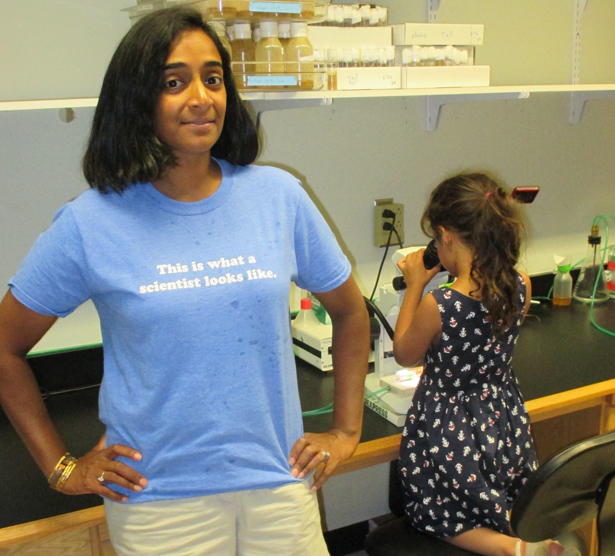
This Is What Science Looks Like at NC State: Nadia Singh

Editor’s note: This post was written by Nadia Singh, an assistant professor of biological sciences at NC State. The post is an entry in an ongoing series that we hope will highlight the diversity of researchers in science, technology, engineering and mathematics. The series is inspired by the This Is What A Scientist Looks Like site.… 

Jul 8, 2014

This Is What Science Looks Like at NC State: Xiaohui Gu

Editor’s note: This post was written by Xiaohui (Helen) Gu, an associate professor of computer science at NC State. The post is an entry in an ongoing series that we hope will highlight the diversity of researchers in science, technology, engineering and mathematics. The series is inspired by the This Is What A Scientist Looks Like… 

Jul 8, 2014

When Faced With Some Sugars, Bacteria Can Be Picky Eaters

Researchers from North Carolina State University and the University of Minnesota have found for the first time that genetically identical strains of bacteria can respond very differently to the presence of sugars and other organic molecules in the environment, with some individual bacteria devouring the sugars and others ignoring it. 

Jul 7, 2014

Science and Cookies: Researchers Tap Into Citizen Science to Shed Light on Ant Diversity

Scientists from North Carolina State University and the University of Florida have combined cookies, citizen science and robust research methods to track the diversity of ant species across the United States, and are now collaborating with international partners to get a global perspective on how ants are moving and surviving in the modern world. 

Jul 2, 2014

Inspired by Nature, Researchers Create Tougher Metal Materials

Drawing inspiration from the structure of bones and bamboo, researchers have found that by gradually changing the internal structure of metals they can make stronger, tougher materials that can be customized for a wide variety of applications – from body armor to automobile parts. 

Jul 1, 2014

This Is What Science Looks Like at NC State: Ahmad Alsabbagh

Editor’s note: This post was written by Ahmad Alsabbagh, who recently completed his Ph.D. in nuclear engineering at NC State. The post is an entry in an ongoing series that we hope will highlight the diversity of researchers in science, technology, engineering and mathematics. The series is inspired by the This Is What A Scientist Looks… 

Jun 24, 2014

This Is What Science Looks Like at NC State: Mahsa Mohiti-Asli

Editor’s note: This post was written by Mahsa Mohiti-Asli, a postdoctoral researcher in the joint Department of Biomedical Engineering at NC State and UNC-Chapel Hill. The post is an entry in an ongoing series that we hope will highlight the diversity of researchers in science, technology, engineering and mathematics. The series is inspired by the This… 

Jun 23, 2014

‘Sensing Skin’ Quickly Detects Cracks, Damage in Concrete Structures

Researchers from North Carolina State University and the University of Eastern Finland have developed new “sensing skin” technology designed to serve as an early warning system for concrete structures, allowing authorities to respond quickly to damage in everything from nuclear facilities to bridges. 

Jun 18, 2014

Trap-Jaw Ants Spreading in Southeastern United States

Trap-jaw ant species are active hunters with venomous stings and jaws powerful enough to fling themselves through the air. According to new research, they are also spreading into new territory in the southeastern United States. The research was done by scientists at North Carolina State University, the Mississippi Entomological Museum, the University of California, Davis… 

Jun 16, 2014

This Is What Science Looks Like at NC State: Mia de los Reyes

Editor’s note: This post comes from Mia de los Reyes, an NC State undergraduate who is double majoring in pure math and physics. A Park Scholar, de los Reyes was also recently awarded both a prestigious Goldwater scholarship and an Astronaut scholarship. The post is part of an ongoing series that we hope will highlight the… 

Jun 13, 2014

Crossing the Goal Line: New Tech Tracks Football in 3-D Space

Referees may soon have a new way of determining whether a football team has scored a touchdown or gotten a first down. Researchers from North Carolina State University and Carnegie Mellon University, in collaboration with Disney Research, have developed a system that can track a football in three-dimensional space using low-frequency magnetic fields.