‘Controlled Evolution’ Dramatically Boosts pDNA Production for Biomedical Manufacturing
For Immediate Release
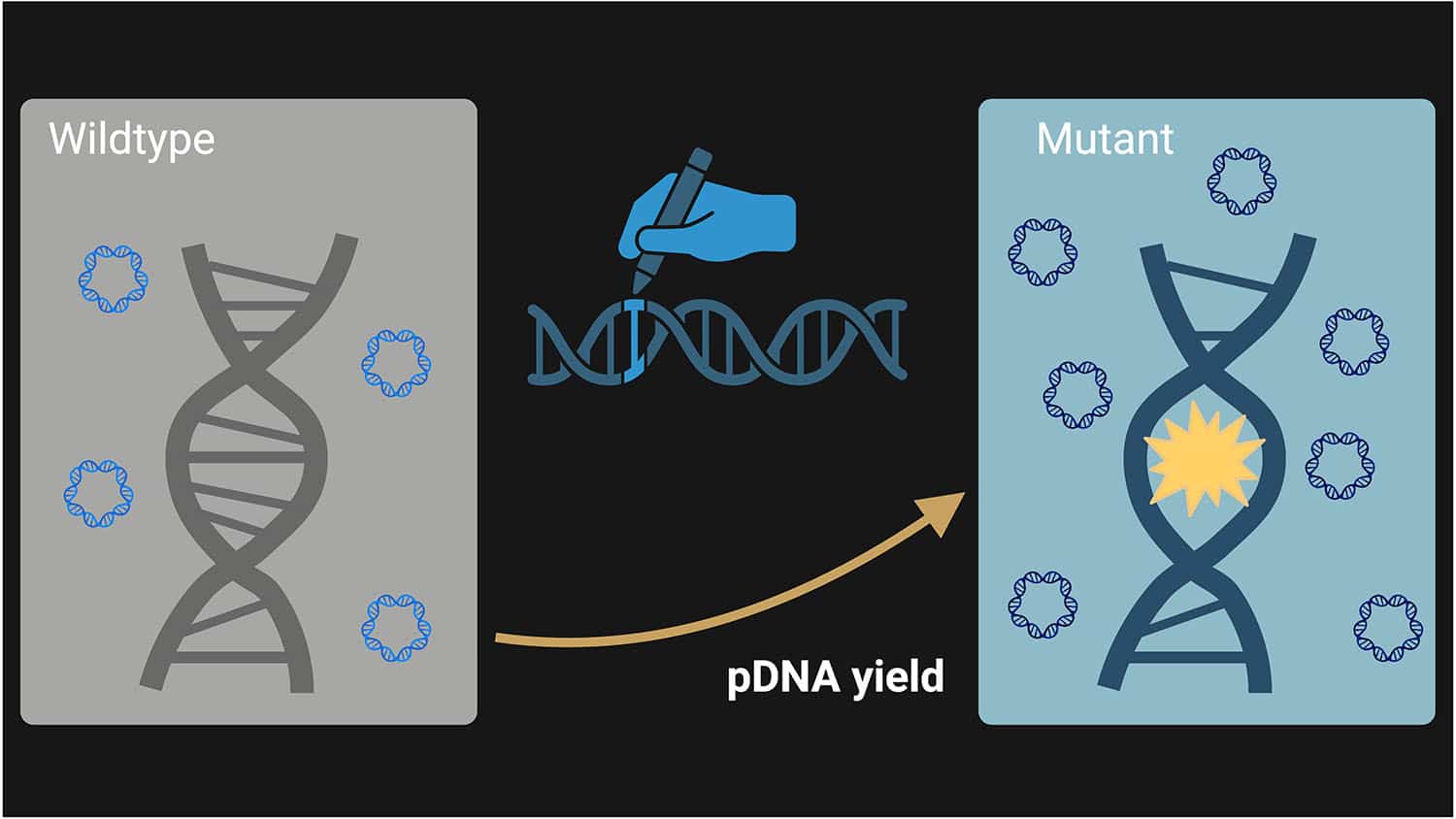
Researchers have controlled the evolution of E. coli bacteria in the lab in order to dramatically increase the amount of plasmid DNA (pDNA) these modified bacteria produce. The advance is significant because pDNA is an essential – and expensive – ingredient in many gene therapies, and the new technique could drive down the cost of these medical treatments.
pDNA are found naturally in many bacteria and differ from other forms of DNA because the double helix shape most people are familiar with forms a circle, rather than the linear shape found in humans and most other organisms.
“pDNA is relatively easy to work with in the lab – it’s stable and easy to modify,” says Nathan Crook, corresponding author of a paper on the work and an assistant professor of chemical and biomolecular engineering at North Carolina State University. “And it is particularly good at introducing genetic information into cells. This combination of traits makes it extremely useful for many gene therapies, as well as many vaccines used in veterinary practice.”
However, obtaining pDNA for use in research and manufacturing is costly.
“pDNA is largely produced by genetically modified bacteria, and can cost as much as $100,000 per gram,” says Crook. “Our goal was to develop E. coli bacteria that are more efficient at producing pDNA, and we were surprised at how successful we were. I thought we might see some small improvement, but this was remarkable.”
“Essentially, we started with a type of E. coli that had already been modified to produce pDNA,” says Zidan Li, first author of the paper and a postdoctoral researcher at NC State. “We introduced mutations into these bacteria and tested them, one by one, to see if any of the mutations resulted in increased pDNA production. We then selected the individual bacteria that had promising characteristics and tested them further to see how well they performed at producing a variety of different pDNAs.”
Specifically, the researchers used their “evolved” line of E. coli to produce five types of pDNA. While all five types of pDNA are well-studied, three types of pDNA are well known as being easier to produce in bulk, while the other two are more difficult to produce.
“At the high end, we found our modified E. coli produced 8.7 times as much pAAV pDNA as the E. coli we started with,” Li says. “pAAV is used in gene therapies and was one of the pDNA types that is traditionally easier to produce in bulk. But even at the lowest end, we were able to increase production of p15A pDNA by a factor of 1.44. That was one of the pDNA types that is traditionally difficult to produce in bulk, and increasing production by 44% is remarkable.”
“We’re optimistic this could significantly reduce manufacturing costs for biomedical applications that rely on pDNA, and could expedite research that relies on pDNA resources,” says Crook. “We look forward to working with partners in the private sector to explore related opportunities.”
The paper, “Inducible genome-wide mutagenesis for improvement of pDNA production by E. coli,” is published open access in the journal Microbial Cell Factories. The paper was co-authored by Ibrahim Al’Abri, a former graduate student and postdoc at NC State; Yihui Zhou, a professor of biological sciences at NC State; and George Sun, a research assistant in the Zhou lab at NC State.
Li, Crook and Al’Abri have filed an invention disclosure pertaining to the engineered E. coli strains developed in this work.
This work was done with support from the North Carolina Biotechnology Center under grant 2022-TRG-6707.
-shipman-
Note to Editors: The study abstract follows.
“Inducible genome-wide mutagenesis for improvement of pDNA production by E. coli”
Authors: Zidan Li, George Sun, Ibrahim Al’Abri, Yihui Zhou and Nathan Crook, North Carolina State University
Published: Aug. 13, Microbial Cell Factories
DOI: 10.1186/s12934-025-02821-x
Abstract: Plasmid DNA (pDNA) is a cost-driving reagent for the production of gene therapies and DNA vaccines. Improving pDNA production in the most common production host (E. coli) has faced obstacles arising from the complex network of genes responsible for pDNA synthesis, with the specific enzyme(s) limiting pDNA yield remaining unidentified. To address this challenge, we employed an inducible genome-wide mutagenesis strategy, combined with fluorescent screening, to isolate E. coli NEB 5α strains with enhanced pDNA production. Following selection, we successfully isolated an E. coli strain (M3) with elevated plasmid copy numbers (PCNs) across multiple origin types. Specifically, we observed a 5.93-fold increase in PCN for the GFP reporter plasmid, a 1.93-fold increase for the gWiz DNA vaccine plasmid, and an 8.7-fold increase for the pAAV-CAGG-eGFP plasmid, all of which contain pUC origins. In addition, plasmids with p15A and pSC101 origins showed 1.44-fold and 1.68-fold increases in PCN, respectively. Whole-genome sequencing of the adapted strain M3 identified 85 mutations, including one in recG, which encodes an ATP-dependent DNA helicase. Replacement of the mutant recG with its wild-type counterpart in the mutant strain resulted in a 63% reduction in PCN, but the recG mutation alone was insufficient to increase PCN in the wild-type strain. These findings suggest that the recG mutation plays a synergistic role with other genomic mutations to drive PCN increases. Taken together, this study presents the development of a pDNA hyperaccumulating E. coli strain with promising applications in industrial and therapeutic pDNA production, while also offering important insights into key genes involved in pDNA production.


