On the day the North Carolina College of Agriculture and Mechanic Arts opened — Oct. 3, 1889 — Alexander Quarles Holladay was inaugurated as the school’s first president.
He took the reins of a movement, not just to fulfill North Carolina’s land-grant mission, some 30 years after the passage of the Morrill Act, but to educate the rural sons—and eventually the daughters — of the state in effective agricultural and manufacturing processes that were handed down generationally but never effectively taught at a technical school operated in a central location.
North Carolina was already a leading agricultural and manufacturing state in the aftermath of the Civil War, but that knowledge was handed down through practical know-how instead of formal education. It was the stated mission of all land-grant schools to spread those traditional hands-in-the-soil and technical skills to young people across the state who were lacking in secondary and college education.
“We know, but cannot do,” Holladay said in his inaugural response that afternoon on the front steps of Main Building, the college’s only facility at the time, which was later renamed in his honor.
Now, almost a century and a half later, NC State University prepares to install Kevin Howell as its 15th leader, in ceremonies at Reynolds Coliseum on Oct. 30. It will be a celebration of what the school has done from its opening day — when just 72 students, mostly from the Old North State, enrolled as the first freshman class — until today, when nearly 40,000 students from around the world come to NC State to learn under the school’s “Think and Do” mantra.
A universitywide Installation Committee co-chaired by Brian Sischo, vice chancellor for University Advancement, and Deanna Dannels, dean of the College of Humanities and Social Sciences, is organizing the event, which will take place during Red and White Week , the annual celebration of all things NC State.
“An installation carries the symbolism of the changing of the guard,” Sischo says. “We’ve only had 15 chancellors in our history. The ceremony is about conferring all the responsibilities on the chancellor, but it’s also a chance for the university to pause and reflect on its history, where we have been and where we are today and to show our excitement about what the future may hold.”
Multiple voices will be part of the hour-long formal academic ceremony to confer power on the duly elected leader, whose responsibilities include oversight of academics, research, outreach, engagement, fundraising and student affairs.
“Like a commencement, this is an academic threshold we are walking through, something that does not happen often,” Dannels says. “It is an important opportunity for the community to hear his vision and to do that in a formalized way.
“These are few and far between, and it’s an important time in our history.”
Not all leaders of the college have been formally installed. There are no records for inaugurations for the school’s second and third presidents, George T. Wilson and Daniel H. Hill Jr., and Col. John Harrelson took a long time to absorb his title as chancellor. Harrelson was appointed dean of administration after North Carolina’s three state schools consolidated into the University System in 1934, and he was officially named dean after the General Assembly passed a bill in 1945 naming the heads of the three state-sponsored schools as chancellor and the head of the system as president.
An official installation is a celebration of not only the institution but also the elected leader. In Howell’s case, it will be a full-circle acknowledgement of the student he was when he arrived on campus from Shelby, North Carolina, and his transformation into the fully prepared leader he has become since graduating with a bachelor’s degree in political science in 1988.
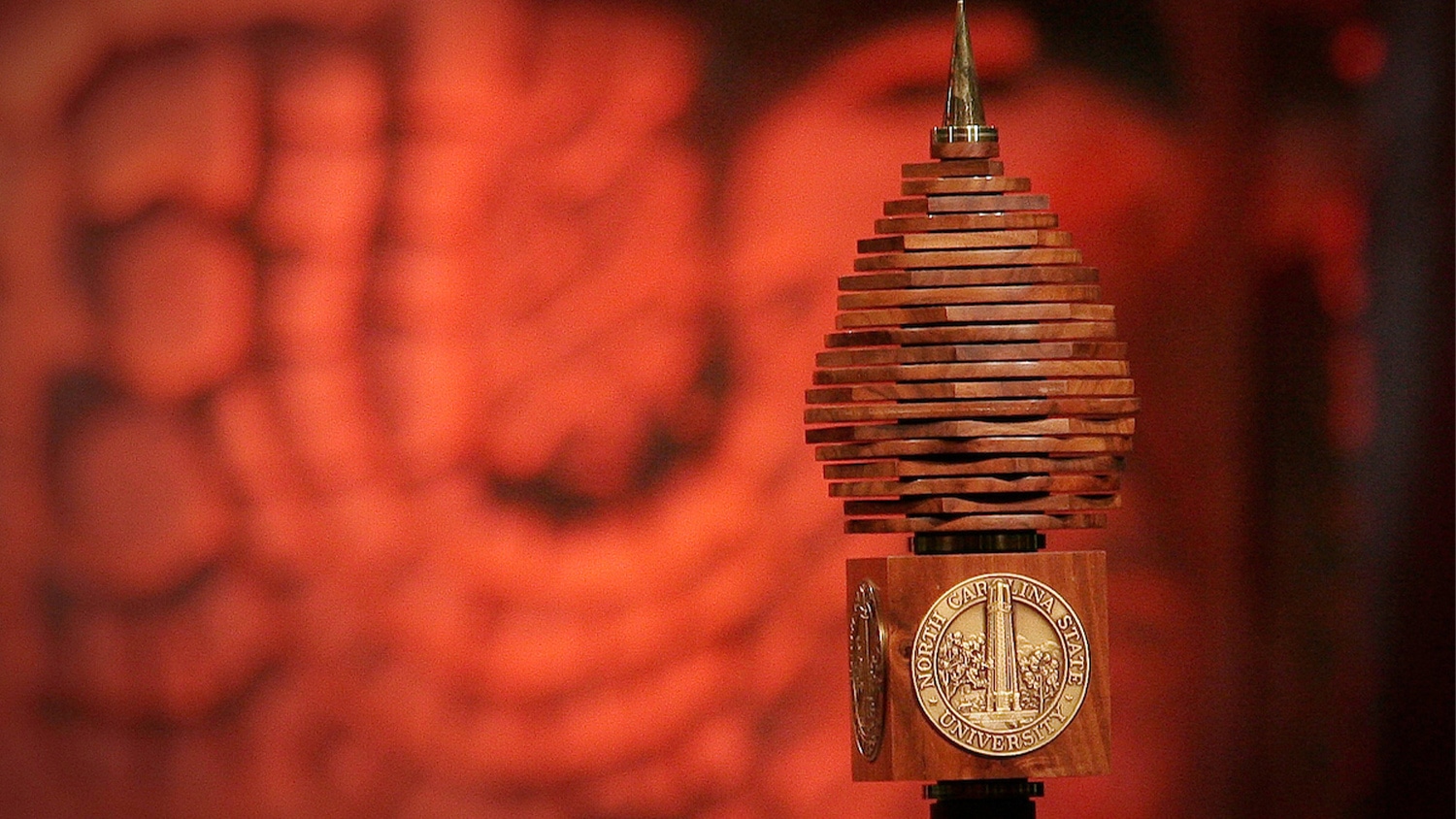
The ceremony will include a processional of faculty leaders, an acknowledgement of state government and university system leaders, an oath of office, student remarks by the current student body president and a formal response by the new chancellor. The occasion will be decorated with full academic regalia, including formal caps, gowns, the university mace and a specially designed university medallion.
It will also be an opportunity for Howell, who was elected in February and took office in May , to formally lay out his vision for the university’s future.
Through the years, those messages have been similar but unique, each celebrating the school’s mission to touch the lives and the futures of the people of the state.
Below are the words, ideas and legacies of Howell’s 14 predecessors.
(Erin Ferrare contributed to the information below.)
Inaugurated: Oct. 3, 1889 | Main Building (now Holladay Hall).Born: Cherry Grove, Virginia.Education: University of Virginia; University of Berlin, specializing in Latin, Greek, modern languages, moral philosophy and law.Professions: Lawyer, educator, state senator, college administrator.
Previous positions: After three years as president of the Stonewall Jackson Institute in Virginia and four at the Florida State Agricultural College in Lakeland, Holladay hoped to move closer to his Virginia birthplace by becoming the first English professor at the new North Carolina College of Agriculture and Mechanic Arts. The Board of Trustees had other ideas after it reviewed his resume and educational background. He was unanimously elected to become NC State’s first president on Aug. 30, 1889, and was officially inaugurated into the post on Oct. 3, the day North Carolina’s first official land-grant college opened its doors to students
Highlights of tenure: Holladay shepherded the founding of the college, using his experience as president at institutions in Virginia and in Florida. Working with a faculty of five on a campus that included just one building, Holladay and his staff quite literally laid the bricks that have stood since the doors opened. The Agricultural Experiment Station was transferred from the North Carolina Department of Agriculture shortly after the college opened. However, only a few utilitarian buildings — barns, electrical shops, a mechanical building, a forge and an infirmary — were added to the physical plant. By the time his wife’s failing health forced Holladay to step down after 10 years in office, more than 300 students from across the state and the college’s first two international students were enrolled, and the faculty expanded.
Fun facts: Holladay, while educated in the classics, was a dedicated arborist. Some of the willow oaks still growing on the grounds of main campus were planted at Holladay’s direction. Also, he served as the school’s first bookkeeper, entering all purchases in his “Book of Incidental Expenses.” His first entry? A box of chalk purchased from Alfred Williams and Company for 25 cents. Also, Holladay strongly disapproved of whistling.Legacy: Main Building, the college’s only structure when it opened in 1889, was renamed Holladay Hall in his honor in 1899 when he retired from his position.
Inaugural response: “While we are striving to make industrious and useful citizens of the young who are entrusted to us, we shall at the same time do our best to make them good patriots and devoted lovers of their mother State. Carolinians have a glorious heritage, and the children of Carolina should learn early to prize it as it deserves. Their chief pride should be in the stainless escutcheon of their State, and their highest honor the privilege of perpetuating and guarding its purity. They ought to love it, and live for it, and — if need be — die for it, as so many of their ancestors have done. They ought to revere, as a sacred thing, the memory of her great sons, and their young hearts ought to throb and tingle at the story of their glorious deeds in the days that are gone.”
Expand to read more Collapse
Elected: July 5, 1899.Hometown: Windsor, North Carolina (Bertie County).Education: Secondary degree from UNC-Chapel Hill; bachelor’s degree from U.S. Naval Academy (ranked first in graduating class); engineering degree from Cornell University.Previous positions: President of UNC-Chapel Hill; president of the University of Texas.
Highlights of tenure: During Winston’s administration, the college added a curriculum in textiles, as well as its first summer school classes for secondary educators from across North Carolina to teach modern techniques in home economics, canning and other preservation of agricultural goods. In the earliest years of Winston’s tenure, there were more female summer school students than male. As North Carolina’s rural schools improved, entrance requirements for NC A&M were gradually raised from 14 to 15 to 16 years old, and 120 scholarships were awarded to qualified students. Courses in engineering and agriculture were added, and teacher education, modern languages and textile training were introduced to the technical curriculum. Student dormitories were added, allowing for an expansion of the student population. Winston’s administration required all students under the age of 21 to live on campus and eat at the dining hall. Varsity and class athletics were introduced during the Holladay administration, and under Winston’s tenure they grew to include football, baseball, track and cross-country.Fun Facts: Because of an incident called the “Thug Revolt,” in which upperclassmen protested the revocation of off-campus privileges, the entire senior class of 1905 went on strike the first month of the 1904-5 school year. In 1907, Winston also devised a contest between the sophomore and freshmen classes to determine the name of the South’s largest dormitory. The freshman class won and promised to end the troublesome practice of upperclassmen hazing freshmen. In appreciation, Winston named the school’s newest and biggest structure the 1911 Building, which still stands on the west end of the Court of North Carolina.
Legacy: Winston Hall, one of NC State’s first buildings dedicated to engineering when it opened in 1910, was named in Winston’s honor. In 1947, the University of North Carolina at Chapel Hill named one of its residence halls in Winston’s honor.
Inaugural response : “Having been invited by the trustees of the North Carolina College of Agriculture and Mechanical [sic ] Arts to accept the presidency of that institution, with a view to developing it to a position of usefulness and efficiency among the foremost technological schools of the country, and this invitation having been warmly seconded by a large number of educators, manufacturers and other citizens of my native state, and after being advised by physicians that the health of my family is dependent on their residence in a colder climate, after careful consideration, it is my duty, to both my family and to my native State, that I return to North Carolina.” (George T. Winston in his resignation letter to the University of Texas.)
Expand to read more Collapse
Elected: July 23, 1908.Hometown : Davidson, North Carolina (Mecklenburg/Iredell/Cabarrus counties).Education: North Carolina Military Academy; Horner and Graves Military Academy; bachelor’s degree, master’s degree and doctor of letters from Davidson College.Prior professions: Writer, part-time librarian.Previous positions: Professor of English and bookkeeping at Middle Georgia College of Military and Agriculture and at North Carolina College of Agriculture and Mechanic Arts, 1889-1908; librarian.
Highlights of tenure: Hill led the school through its 25th anniversary and oversaw the creation of the Agriculture Extension Service to reach farmers across the state of North Carolina. Today, NC State Extension jointly operates a total of 101 extension offices in partnership with North Carolina A&T State. Among the many structures added to the school were the YMCA Building, thanks to a gift from John D. Rockefeller, a new dining hall, new electrical shops and laboratories. Basketball and tennis were added as varsity sports.Fun fact: Like Holladay, Hill taught English. In fact, Hill was selected to be the school’s first English professor after Holladay accepted the presidency of the new school, and Hill served in that job and as vice president of the school under Winston until Hill too was selected as president. He resigned his position in 1916 to write a two-volume history of North Carolinians’ participation in the Civil War and to serve as the college’s librarian.
Legacy: As part of NC State’s building boom of the 1920s, a new library opened on main campus, named to honor Hill, one of the school’s first part-time librarians. In 1925 that honor was transferred to the first wing of the main campus library when it opened in 1956, and the original library was later renamed Brooks Hall in honor of Eugene Clyde Brooks, who was chancellor from 1923 to 1934.
Election response: “Colleges grow generally in proportion as they deserve to grow. If an institution squarely fulfills its mission of sending forth yearly painstaking, upright and forceful men — men capable of meeting all issues, successfully, it will not fail to find ways to make large its borders. Our college is still young in years, but already rich in alert, vigorous and successful body of young graduates, who are adding no small part to the agricultural uplift and to the engineering and manufacturing enterprises of the state. We want each year to increase this number of educated industrial workers. We desire also to increase each year the efficiency of our alumni by providing our students with better equipment, with more teachers and with necessary buildings.” (Daniel Harvey Hill Jr. in address to students.)
Expand to read more Collapse
Birthplace: Wake County, North Carolina.Education: B.S. in civil engineering, Lehigh University; Doctor of Laws (honorary), Lehigh and Wake Forest; Doctor of Engineering (honorary), NC State College.Prior professions: Civil engineer, professor.Previous positions: Professor of civil engineering at North Carolina A&M 1890-1916. Vice president of the college after D.H. Hill became president.
Highlights of tenure: As president, Riddick served during the most turbulent time in college history, as campus was turned into a military school shortly after he was installed to train officers for the Great War in Europe. He also navigated the difficulties of the Spanish Flu pandemic of 1918 that claimed 13 students as well as his own niece, Eliza Riddick, a nurse who caught the dread disease while attending sick students at the school. She was one of five members of Riddick’s family who volunteered to care for students at the school infirmary. In the aftermath of the war, Riddick oversaw the school’s greatest expansion, nearly doubling the size of the faculty and student enrollment. He saw the school’s physical plant grow from Holladay Hall and an outlying stable to a campus of more than 45 buildings and a centerpiece of the city of Raleigh.
Fun fact: Riddick served as NC State’s football coach in 1896-97 and was considered by many to be the State College “Father of Athletics.” In keeping with that legacy, Riddick and the university’s new leadership left his late afternoon inauguration at Pullen Hall to go to downtown Raleigh for a State-Duke basketball game at the Municipal Auditorium, before returning later that night for an inaugural reception at the school YMCA. (State won 16-14 in overtime.)Legacy: The only on-campus football stadium in school history was named in Riddick’s honor in 1917, as was Riddick Hall (née Riddick Engineering Laboratories). While use of the stadium was discontinued in 1965 and it was eventually demolished over the course of the following 40 years, Riddick Hall still houses lab facilities and classrooms.
Inaugural response: “Here in the presence of God and these witnesses and asking His help and guidance I vow to give my best efforts to the work, hoping that zeal and earnestness of purpose and an enduring faith in the cause may compensate for any lack of experience and ability. I should, indeed, hold back from the task if I did not know that by the wise building of my predecessor and those who preceded him the college has been placed upon a firm foundation, well grounded, deep in the hearts of the people, and that the burden I undertake rests not upon me alone but also efficient co-workers.
“It has gone into other institutions of higher education in the State. It has modified their ideals, broadened their curricula, brought their faculties in closer touch with outside affairs and bridged the moat which had surrounded our educational castles, thus making it easier for the college graduate to get out and find his place in life, and at the same time, opening the way for a greater number of those outside to come in; in this way, higher education is made more practical, and therefore, more useful, without losing any of its cultural value.”
Expand to read more Collapse
Inaugurated: May 26, 1924 | Pullen Hall.Hometown: Greene County, North Carolina.Education: Bachelor’s degree from Trinity College (now Duke); Doctor of Letters from Davidson, terminal degree in arts, humanities and social sciences.Prior professions: Educator, editor.
Prior positions: North Carolina public school teacher, principal and superintendent. During 1906-23 he worked as the editor of Raleigh’s News & Observer and the North Carolina Educator , an education journal he founded. He was named head of the Department of Education at Trinity College in 1907, where he served until 1919 when he was appointed state superintendent of public instruction.
Highlights of tenure: Because of massive growth in the number of students and faculty, and in the physical plant, in 1923 Brooks and George F. Zook of the Washington Bureau of Education completely reorganized the college’s administrative structure to create the schools of agriculture, engineering, business and general science. Brooks navigated the school through the Great Depression, when enrollment dropped from 2,000 to 1,500 and funding from the state was diminished. He also conferred the college’s first three graduate degrees to women in 1927.
Fun fact: While many of the members of the Watauga Club and early Board of Trustees members published or edited magazines, weekly newsletters and other publications, Brooks is the only one to edit a local daily, which embraced his tenure with great optimism. His inauguration, which was part of the school’s 37th commencement exercises, ended with a barbecue banquet on the grounds of the college.
Legacy: NC State’s first library, built in 1925 and originally named for President Hill, was renamed Brooks Hall in his honor. After a massive redesign and renovation in 1956, the building is now home to the College of Design.
Inaugural response: “What is the purpose of the colleges and universities of today — to teach the truth, of course, but the truth of what? Are the institutions educating young men to enter some trade — that is, narrow opportunity for the individual through the exercise of technical skill, or are they opening the avenue of some profession? What is the relation of legislation to social and industrial progress? Is it a greater factor than technical skill? How may we erect a fair standard by which we may measure the value of a local government? These are the questions we must answer.”
Expand to read more Collapse
Hometown: Lawndale, North Carolina (Cleveland County).Education: M.S. in mechanical engineering, North Carolina State College, 1909.Previous positions: Officer in U.S. Army, reaching rank of colonel during World War II.Fun fact: Harrelson played football and baseball at NC State and served in both world wars, seeing combat in the first and serving as a personnel administrator in the second.
Highlights of tenure: NC State’s longest-serving leader and the first alumnus to lead the school, Harrelson was first named dean of administration in 1934 when Gov. O. Max Gardner merged the state’s three public institutions (UNC-Chapel Hill, Women’s College in Greensboro and NC State College in Raleigh) into a consolidated university system. Harrelson later assumed the role of chancellor, a first for the college, as NC State began an era of enormous growth while educating veterans of World War II. During his administration, the college established the influential schools of Design and Forestry and opened Reynolds Coliseum, one of the country’s most important multipurpose facilities.Legacy: Harrelson Hall, the largest and most detested classroom building in the UNC Consolidated System, was named in his honor. The cylindrical building was deconstructed in 2016, and no other facility now bears his name. Woodson Hall, named for recently retired chancellor Randy Woodson, is being built in Harrelson Hall’s footprint and is slated to open in 2027.
Appointment response: “We welcome you because in applying for admission to the College, you have signified a desire for a preparation that will enable you to better meet the problems of life and thereby render a more efficient service to the State and the Nation. We welcome you at this period of reconstruction, when the State, the Nation, and the World are rebuilding their economic and social orders. You are entering or returning to college at a time when the educational institutions are becoming more and more the laboratories of our economic and social structures. Your opportunities are now in the history of America. We expect to guide you through the Student Government, the student Y.M.C.A., and through other student and college organizations, to an appreciation of the better things in life. At State College we are conscious of the fact that success in life depends on character. Character, reinforced by culture and specialized training, places the young graduate in a position to achieve success in later life. The College expects to make every effort during the next session to lead you to a realization of value of broad training and cultural background.” (Col. John William Harrelson, in an address to the student body shortly after he was appointed dean of administration.)
Expand to read more Collapse
Inaugurated: Feb. 22, 1954 | Reynolds Coliseum.Hometown: China Grove, North Carolina (Rowan County).Education: Bachelor’s degree in biological sciences, Catawba College; Master’s degree and Ph.D. in zoology, the University of Pittsburgh.Prior professions: College educator, geneticist.Previous positions: Joined NC State faculty in 1930 as a professor of zoology. Appointed associate dean of the School of Agriculture in 1948. After six years as chancellor, he returned to the faculty as professor emeritus of poultry genetics.
Highlights of tenure: The campus added 10 buildings during Bostian’s administration, including one for his field of study, the biological sciences, as well as one for mechanical engineering and a new library. He expanded scholarship programs, created the post of director of student affairs and inaugurated the Faculty Senate to give teachers a stronger voice in academic affairs. He also used his persuasive skills on North Carolina Gov. Luther Hodges to turn 800 acres between Raleigh, Chapel Hill and Durham into the Research Triangle Park to draw high-tech businesses into the state.
Fun fact: Bostian never applied for the job as chancellor but was elected from dozens of nominated candidates. He agreed to take the job as long as he served only a few years. He stepped down after just six years, saying he preferred to teach and he missed his students. He taught at NC State for nearly 20 years after leaving the chancellor post.Legacy: Bostian Hall, a three-story biological sciences building located on the west side of University Plaza, was named in the former chancellor’s honor. When Bostian died in 2000, The New York Times published his obituary
Inaugural response: “For this occasion, it seems appropriate for us to consider briefly the story of our past, the scope of our present activities, and the almost unlimited opportunities of the future. Our broad functions are those of all colleges: To maintain and preserve the knowledge of the past; to see new knowledge; to impart this knowledge to others. As a member of the national system of land-grant colleges and as a unit of our Greater University with definitely allocated functions, State College has more specific aims and purposes. We have the responsibility of training the leadership for our agriculture and for our industries, and for making known to our farmers and industrialists the most efficient methods and techniques. Everything we seek to do has a direct bearing on the economic development of our state and the prosperity of our people. While every institution of higher learning makes direct or indirect contributions to the progress of a community and region, State College has unique responsibilities not held by any other college in our state. There is overwhelming evidence that the land-grant colleges, including our own, have been quite successful in achieving the claims made for them by Justin S. Morrill, who introduced the bill authorizing them, saying that the leading object would be ‘without excluding other scientific or classical studies, to teach such branches of learning as are related to agriculture and the mechanic arts … in order to promote the liberal and practical education of the industrial classes in the several pursuits and professions of life.’”
Expand to read more Collapse
Inaugurated: March 3, 1960 | Reynolds Coliseum.Hometown: Yazoo City, MississippiEducation: B.S. from Mississippi State; M.A. from Duke; Ph.D. in politcal science from Princeton.Previous professions: Political scientist, professor, college administrator.Prior positions: Educator at Holmes Junior College, Vanderbilt University; president at Alabama College (now the University of Montevallo) and the University of Arkansas.Fun fact: Caldwell was the second head of the college to be installed on Founders’ Day, 73 years after Holladay was inaugurated on the day the school opened.
Highlights of tenure: NC State’s second-longest-serving chancellor, Caldwell helped guide the school through its elevation from college to university status, conferred the first undergraduate degrees to both African American and female students and oversaw a strong period of student and facility growth. Among the facilities opened during his leadership were Harrelson Hall, Carter Stadium, Talley Student Center and the school’s second nuclear reactor.Legacy: Caldwell Hall, which adjoins Tompkins and Winslow halls on main campus, was renamed from the Link Building in Caldwell’s honor in 1984.
Inaugural response: “State College mirrors the new America with its fresh concern for beauty of form, sight, sound and eloquence of thought. Our educational objectives are fully contemporary with emerging emphasis on fundamental science as the basis for advancing technology. Man’s greatest enslaver has always been ignorance. Man’s greatest emancipator has always been truth understood. North Carolina State College is dedicated to the process of freeing men’s minds. There have been brought into being here great faculties in the biological sciences, the physical sciences, the social sciences and even the humanities, great faculties indeed in the fields of the applied sciences and technology. We will have ideas, lots of them, ideas about how we can improve the quality of what we do, broaden the service of this institution and strengthen the support we even now enjoy. As the channels are continuously held open for our concepts and needs to be presented with reason and clarity, the full flowering of North Carolina State College will be assured those who work here and those who come here to learn.”
Expand to read more Collapse
Hometown : Holt, Alabama.Education : B.S., master’s and Ph.D. in biology from Harvard.Prior professions : Educator, assistant dean, and vice president of student affairs at Alabama.Previous positions : Professor of biology at Alabama from 1961 until his subsequent appointment as assistant dean of the College of Arts and Sciences, followed by his appointment as vice president for student affairs in 1969.
Fun Facts: Thomas turned down a full athletic scholarship to play football at Alabama in his home state to accept a full academic scholarship at Harvard, where he earned all three of his academic degrees in biological sciences.
Highlights of tenure: Enrollment at the university grew by 25% and surpassed 20,000 for the first time while Thomas was in office. He oversaw the establishment of the School of Veterinary Medicine, the Center for Economic and Business Studies, the North Carolina Japan Center and the Caldwell Fellows scholarship program. D.H. Hill Jr. Library acquired its 1 millionth volume.
Legacy: Southwest Gardner Hall was renamed to Thomas Hall in his honor on Nov. 19, 2009 (see Thomas’ obituary here ).
Installation response: “The turning point we face offers the possibility of a new upward trend, a trend I would characterize as a period of emergence — emergence from disillusionment. The spiral behind us has now become clear. Its rise was characterized by unprecedented growth and expansion in population, discovery, in achievement, in productivity and in outlook. It is apparent that the excessively expansionistic and seemingly limitless nature of these dimensions contributed to the sharp downward sweep of the spiral which followed. As our society emerges from a period of great disillusionment, it is increasingly important to have a highly educated citizenry. In this emergence it is important that we sharpen the definition of the services we offer, being careful not to advertise falsely or oversell beyond our capacity to deliver. It (this new era) will be characterized by controlled or guided growth on the one hand and controlled or guided entrenchment on the other.”
Expand to read more Collapse
Inaugurated: Sept. 23, 1983 | Jane S. McKimmon Center.Hometown: Yonkers, New York.Education: B.S., Master’s and Ph.D. in endocrinology from Rutgers.Prior professions: Professor, university administrator.Previous positions: Professor of dairy physiology; founding chancellor of the University System of New Hampshire.
Highlights of tenure: Poulton oversaw the year-long celebration of the university’s centennial, which included accepting more than 600 acres from the state of North Carolina to create Centennial Campus, NC State’s research, partnership and innovation campus. Among the achievements during his tenure were the broadening of NC State’s liberal arts offerings and the expansion of the School of Textiles. He was also responsible for the expansion of the university’s graduate research programs and for laying the foundation for NC State acquiring a Phi Beta Kappa chapter. Poulton was installed in nontraditional ceremonies at the Jane S. McKimmon Center that included a three-day universitywide symposium exploring “The Role of Continuing Education in a High-Tech Society.” He was a long-time advocate for distance learning, well before the invention of the internet, and continued that work after arriving in Raleigh.
Fun fact: Known for his love of athletics, Poulton was one of the university’s most vocal supporters in all sports. A local newspaper columnist once wrote about his first invitation to the chancellor’s box at Carter-Finley Stadium, where he observed a loud fan vehemently disagreeing with an official’s call, with verbal insults and some profanity. The writer mentioned to the guest next to him that the fan needed to calm down before he was asked to leave by the chancellor. “What do you mean?” the other guest said. “That is the chancellor.”
Legacy: One of the first buildings dedicated on Centennial Campus was renamed the Poulton Innovation Center in 2013. Poulton’s lasting impact, however, is his leadership in more than tripling the size of the original campus and working with Claude McKinney, dean of the College of Design, to develop a master plan for what became Centennial Campus (obituary)
Installation response: “The office of the chancellor is an important office, but I don’t forget that what’s really important about this institution is the interaction between the faculty and students. [NC State] is more than just a physical presence. It is a living spirit that exists in the hearts and minds of thousands of students, faculty, alumni and friends. [My guidance is:] Love the institution. Respect and protect it. Encourage and serve it. Share in its joys and disappointments. Society dictates the immediate imperative for this university to achieve and operate at the highest level of sophistication and to achieve excellence in all our functions. Our commitment is that our students will indeed be liberally educated.”
Expand to read more Collapse
Installed: Oct. 23, 1991 | Reynolds Coliseum.Hometown: Bryson City, North Carolina (Swain County).Education: B.S. in electrical engineering from NC State (1960); M.S. and Ph.D. from Duke in electrical engineering (1962, ’65).Previous professions: U.S. Navy aviation electronics technician, research assistant, professor.Prior positions: Adjunct assistant professor, associate professor of solid-state microelectronics division, department head and dean, all within the College of Engineering at NC State.
Fun fact: Monteith, the second NC State graduate to serve as the university’s chancellor, instituted the university’s fall commencement in 1991, conferring degrees upon more than 1,900 graduates at Reynolds Coliseum. Two years later, he banned smoking in all indoor facilities on campus, a bold move at a school with strong ties to tobacco research. He was installed as part of the university’s sixth-annual Honors Convocation, nearly two years after assuming the duties of chancellor, first as an interim and then as the permanent successor to Bruce Poulton.
Highlights of tenure: When he took over as the university’s top administrator, there was only one building on Centennial Campus. He oversaw plans that turned the new campus into a national leader in public-private research, and he began the development of what became the Lonnie Poole Golf Course, the Dorothy and Roy Park Alumni Center and the StateView Hotel. He significantly changed the office of the provost and added the First-Year College, a chapter of the Phi Beta Kappa honor society and the Park Scholarships program. Two of his most significant accomplishments included improving NC State’s research libraries and establishing the College of Management. Monteith led the university through turbulent times and some difficult transitions, then stepped away when he believed the hurdles he faced as leader were cleared. Importantly, the university’s research funding increased nearly 77% during his tenure, from $170 million in his first year to almost $300 million in his last.
Legacy: The $45.5 million Engineering Graduate Research Center on Centennial Campus was renamed the Monteith Research Center in his honor by the Board of Trustees. In 2015, he was inducted into NC State’s Electrical and Computer Engineering Hall of Fame (obituary) .
Installation response: “It’s been our mission to change as the economic and socioeconomic interests of North Carolinians changed and as the forefront of knowledge expanded. No, I do not think that higher education can solve those problems single-handedly. However, progress will require individual, institutional and national commitment to deal with reason and not simply focus on excuses.”
Expand to read more Collapse
Installed: April 17, 1999 | Reynolds Coliseum.Hometown: Canton, Ohio.Education: B.S. in chemistry from Notre Dame; master’s from Cleveland State; Ph.D from Dartmouth.Previous professions: Organic chemist, plant biologist, researcher.Prior positions: Professor and vice president of research, University of Texas.
Highlights of tenure: Fox, a physical organic chemist who was elected into the National Academy of Sciences in 1994 and earned the National Medal of Science in 2010, ushered in an era of change, particularly in developing Centennial Campus, increasing research funding and improving athletic facilities. She guided the university into the 21st century, bolstering the institution’s identity as a leading land-grant university. She and other leaders of the 17-school UNC System played a prominent role in lobbying the North Carolina General Assembly for the historic $3.1 billion Higher Education Improvement Bond Referendum in 2000. She invested NC State’s portion in expanding and developing the master plan for Centennial Campus, the College of Textiles and the College of Engineering. In athletics, Fox backed the expansion of NC State’s facilities, which had long languished without renovation or replacement. In 1999, the Entertainment and Sports Arena (now the Lenovo Center) opened in partnership with the NHL’s Carolina Hurricanes. In 2001, the athletics department broke ground on what eventually became $150 million worth of new facilities, improvements and renovations at Carter-Finley Stadium and on campus.
Fun fact: Fox, NC State’s first female chancellor, was responsible for two seemingly long-standing traditions: the Chancellor’s Choice Howling Cow Ice Cream flavor (vanilla with a raspberry swirl and chocolate chips, in her case) and lighting the iconic Memorial Tower red after specific campus accomplishments like major faculty awards and athletics victories. Both were instituted in the last 25 years.
Legacy: In 2004, the first building constructed with funding from the 2000 educational bonds Fox championed was a science research center on Central Campus that included industrial laboratories, classrooms and greenhouses for the horticultural sciences. It was named the Marye Anne Fox Science Teaching Laboratory in honor of her service to the university. (Obituary.)
Installation response: “What do I see in the future for NC State? I see an exceptional campus community, one that fosters diversity among our people and supports access, equity and opportunity to all who can take advantage of the NC State experience. I see an environment that encourages problem-solving and interdisciplinary work, because the creative act is inherently cross-cultural and intellectual. I see the possibility of forging new strategic alliances as integral components of what we do, proudly upholding these kinds of collaborations on our Centennial Campus as truly the model for the research university of the next century. And I see a willingness to be held accountable to those who support us, as we deliver our services efficiently and effectively. While I am chancellor, I will ensure that at NC State the word ‘academic’ will never mean useless, sterile or irrelevant. I promise to help provide an infrastructure that allows our people to flourish. As chancellor, I will stand back and let them relish in their success. I will try my best to make sound decisions that do not permit the urgent to supersede the important.”
Expand to read more Collapse
Hometown: Ashland, Ohio.Education: B.S. in bacteriology from DePauw University; M.S. and Ph.D. in food technology from Iowa State.Previous Professions: Educator, associate dean, dean, provost.Prior Positions: Associate dean and director of resident instruction at the University of Missouri; professor of food science and human nutrition at the University of Florida; associate dean of academic programs at the College of Agriculture and Life Sciences and provost at NC State.
Highlights of tenure: Oblinger oversaw the completion of a capital campaign intended to raise $600 million that ended by raising more than twice that much: $1.37 billion. During his tenure, NC State expanded facilities on Centennial Campus through the Higher Education Improvement Bond Referendum and dedicated SAS Hall, a $36 million mathematics and statistics building. Total student enrollment topped 30,000 students for the first time in 2008, and NC State expanded academic agreements with universities in Europe, China and South America.
Fun fact: Oblinger’s installation was the first appearance of the university mace, an ancient academic tradition that dates back to the Middle Ages. Designed by Marvin Malecha, dean of NC State’s College of Design, the mace is made of western North Carolina walnut, stone mined in the state and a brass ring with the name of all previous chancellors. Malecha was the chair of Oblinger’s installation committee.
Legacy: Oblinger is the only person to hold the positions of professor, dean, provost and chancellor during his tenure at NC State.
Installation response: “NC State has three overriding values that ensure we will never be satisfied with the status quo but will always be stretching for that next great achievement. Those three values are people, innovation and action. Leadership is not about always being in the front of the room. Real leadership is about seeing a need, building a coalition and getting results. NC State is a leader in the truest sense of the word.”
Expand to read more Collapse
Inaugurated: Oct. 25, 2010 | Reynolds Coliseum.Hometown: Arkadelphia, Arkansas.Education: B.S. in chemistry and horticulture from Arkansas; M.S. and Ph.D. in plant physiology from Cornell.Previous professions: Educator, administrator.Previous positions: Assistant professor, Louisiana State; professor of horticulture, department head, director of Office of Agriculture Research Programs, dean of agriculture, provost and dean of academic administration at Purdue University.
Highlights of tenure: Woodson led “Think and Do the Extraordinary,” the largest capital campaign in school history, raising more than $2.1 billion and expanding the university endowment to $2.22 billion as of 2025. Much of that financial support came from donations made on six consecutive Days of Giving, which began under his administration. Woodson was a stabilizing force following a period in which the university had had four leaders (two permanent chancellors and two interims) in the previous seven years, and the state of North Carolina reduced appropriations to all institutions in the university system during the economic downturn of 2008. He approved efforts to renovate Talley Student Union and Reynolds Coliseum and deconstruct Harrelson Hall, as well as general campuswide beautification projects. On Centennial Campus, the university added the Hunt Library, Fitts-Woolard Hall, Wolf Ridge and the North Carolina Plant Sciences Initiative. Early in his tenure, Woodson made some structural changes, migrating all of the original departments in the College of Physical and Mathematical Sciences and some of the faculty, students, staff and degree programs in the College of Agriculture and Life Sciences to form the new College of Sciences.
Legacy: In 2023, the university broke ground on a new $180 million Integrative Sciences Building in the heart of University Plaza, which will be dedicated as Woodson Hall in his honor when it opens in 2027. (A Chancellor’s First Day, Celebrating Transformation )
Fun fact: Woodson always shared his love of bluegrass and classic rock music, which began even before he and his girlfriend, Susan (whom he later married), helped get Rolling Stones members Keith Richards and Charlie Watts released from jail in their hometown of Fordyce, Arkansas. Woodson enjoyed jam sessions with students and professional performers during his tenure as chancellor, including appearances on the main music stage at Packapalooza on several occasions.
Inaugural response: “As we consider how to move NC State forward, there are three things that need our focus and attention: the success of our students and faculty, engagement in economic development and organizational matters. … [Paraphrasing Nobel Prize-winning physicist Ernest Rutherford] Ladies and gentlemen, we have run out of money. It’s time to start thinking. We can overcome the challenges of a weak economy by growing our endowment. We have to get our endowment to sufficient levels to help us weather these economic storms and to have a differentiator to make this institution great. We cannot rely on the state for all of our needs.”
Expand to read more Collapse