For Immediate Release
An interdisciplinary team of researchers has created an open-source website to learn what different organisms eat, and what eats them. The site – called Who Eats Whom – draws on data from a worldwide citizen science platform and serves as both a valuable resource for ecological research and an educational tool to advance public understanding of the global food web.
“Our understanding of what different organisms eat is incomplete, and is often scattered across the academic literature,” says Bradley Allf, corresponding author of a paper on the work who began this project while in graduate school at North Carolina State University. “An online platform called iNaturalist captures peoples’ observations of organisms and was used to advance our understanding of which organisms live in different locations. This work expands on that, tapping into information on iNaturalist about trophic interactions – what organisms eat – to create a publicly-available website that could be used to shed light on feeding interactions.” Allf is currently a postdoctoral researcher at Colorado State University.
“I came to this project because I’m interested in designing usable interactive tools and learning environments,” says Aditi Mallavarapu, co-author of the paper and an assistant professor of computer science at NC State. “Complex problems are particularly appealing, and the food web is an incredibly complex system. We wanted to create a website that would be usable, visually engaging, and ethical in how it handled the data citizen scientists contributed. We wanted this to help both researchers and the public understand these complex feeding relationships.”
To that end, the researchers created the Who Eats Whom project, tapping into the iNaturalist platform, where the public can share photos, video and audio of organisms. Specifically, the project allows iNaturalist users to submit details of feeding interactions by explicitly tagging both predator and prey in photos and video (though the “predator” could be an herbivore and the “prey” could be a plant).
“Basically, Who Eats Whom gives us information on what different species eat and what eats different species,” Allf says.
Who Eats Whom observations are catalogued on an easily-searchable website, allowing users to explore the trophic interactions that have been recorded. To date, the project has logged approximately 17,000 observations of trophic interactions involving about 5,700 species. The observations have come from around 2,000 observers from more than 100 countries.
“One of the interesting observations at this point is the extent to which the public is interested not only in charismatic predators like lions or wolves, but in smaller trophic relationships such as the insects that eat persimmon leaves,” says Mallavarapu. “People are using the site to explore a wide variety of trophic relationships tied to their personal interests and local surroundings.”
“Moving forward, we can use Who Eats Whom to identify novel trophic relationships that we can contribute to the academic literature,” says Allf. “Ideally, it will continue to grow and can potentially serve as a parallel database that can complement the academic literature, by compiling as much of this information in one place as possible. We’re also excited about its utility for education and public engagement.”
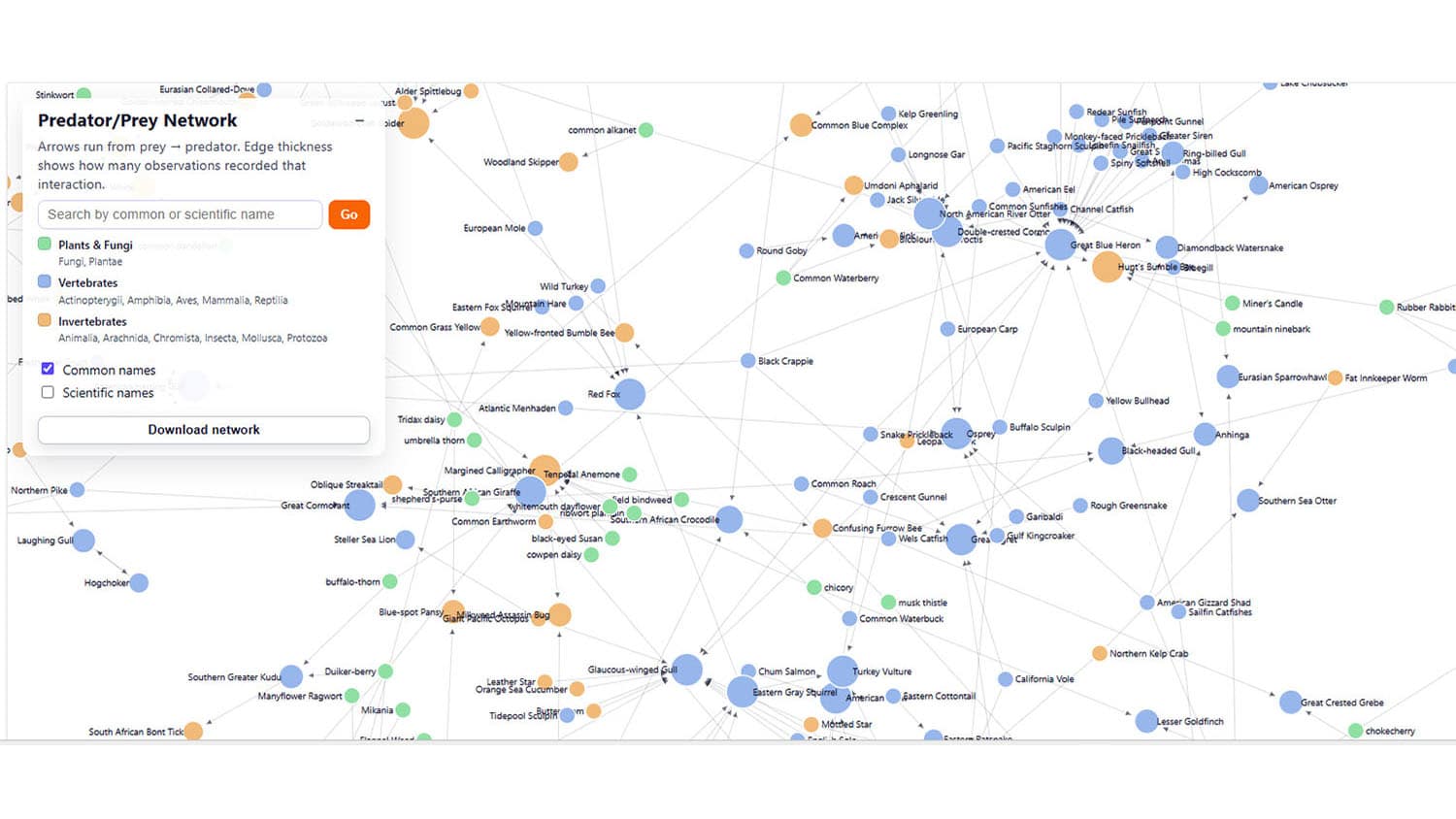
“One of the features I’m excited about is the visual representation of this planetary scale food web, capturing how all these trophic interactions relate to each other and how those relationships change over time. We are still working on developing this interface,” says Mallavarapu. “There is a simple version online now, but we’re in the process of adding more features that could afford exploration of feeding patterns and ask questions like, ‘What do I plant to attract hummingbirds in North Carolina?’”
The researchers are also in the process of developing tools that will facilitate efforts to validate submissions to the Who Eats Whom database on iNaturalist.
“We’ve also developed some educational games that make use of the database, aimed at helping children understand the food web and the dependencies it captures,” says Mallavarapu. “We’re interested in expanding on those, if we can secure funding.”
The paper, “Who Eats Whom? A global food web derived from citizen science,” is published in the open-access journal PLOS Biology. Senior author on the paper is Rob Dunn, a professor in NC State’s College of Agriculture and Life Sciences. Additional authors include Nikhil Vasudeva, a former undergraduate at NC State; and David Kikuchi, an assistant professor of integrative biology at Oregon State University.
The researchers would like to thank the many NC State students who have contributed to developing the Who Eats Whom project – including Maithili Bhoop, Adam Biscoe, Surabhi Nair and Lavanya Middha – as well as the many iNaturalist users whose efforts have made the project possible.
-shipman-
Note to Editors: The study abstract follows.
“Who Eats Whom? A global food web derived from citizen science”
Authors: Bradley C Allf, Colorado State University; Aditi Mallavarapu, Nikhil Vasudeva and Robert R Dunn, North Carolina State University; David W Kikuchi, Oregon State University
Published: Sept. 22, PLOS Biology
DOI: https://doi.org/10.1371/journal.pbio.3003988
Abstract: Citizen science contains abundant yet underutilized data about species interactions. We present Who Eats Whom, a database and public engagement tool for searching and visualizing thousands of feeding relationships derived from iNaturalist data.