
Kasey Wagoner is an assistant professor of physics at NC State who is interested in the oldest light in the universe – the cosmic microwave background – as well as the physics of sports. He wrote this piece examining the physics of football’s dynamic kickoff. You can also read his explanation of the physics behind figure skating jumps. You can find more information, including calculations and python code, on his Substack.
Whether you’re a diehard football fanatic or a non-fan who watches solely for the commercials, you’ll probably pay attention to the opening kickoff during the Super Bowl. What one year ago was perfunctory – a kickoff returner watching the kicked ball sail over his head into, or through, the end zone – is now an exciting play, thanks to the National Football League’s new Dynamic Kickoff rule.
Kickoffs have long been known to be one of the most dangerous plays in all of sports, as high-speed collisions were the rule, and not the exception. So when developing the rules of the Dynamic Kickoff, the NFL almost certainly wanted to do everything possible to make things exciting while minimizing the chance for injury. There are two significant rule changes that reduce the likelihood for an injury, so let’s explore the physics of both rules!
First off, players on the kicking team must remain stationary until the ball is caught. This is in contrast to the previous rule, in which kicking team players could start moving when the ball was kicked. The plot below shows this. The colored curves show how one would-be tackler speeds up after taking off. From the plot we see that at the time of the catch, the tackler in the old system (blue lines) is at nearly max speed, while the same tackler in the new system (red lines) is still at rest.
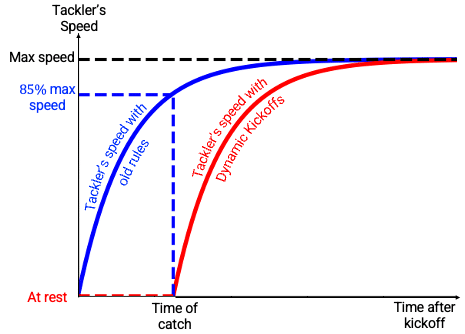
This all means that under the old rules, would-be tacklers are running very fast for a much larger portion of the play, leading to a larger number of high-speed collisions which can lead to injuries.
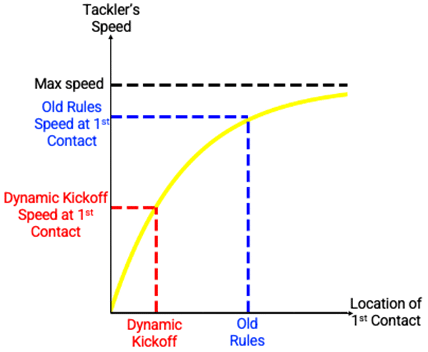
Dynamic Kickoffs have another rule that helps reduce injuries. The new rules dictate that most of the players on the kicking and receiving team must line up 5 yards away from each other, while they started 15 yards apart under the old rules. Moreover, in the past many of the players lined up even farther apart at the kickoff. The figure below shows how the reduced distance between the players at the time of kickoff means that the tacklers aren’t able to get to as high of a speed when they encounter a blocker. If a would-be tackler can’t reach their top speed before being blocked, they likely never will hit that speed, meaning they’re less likely to end up in an injury-causing high-speed collision.
For NFL fans, the Dynamic Kickoff has made watching kickoffs more exciting. It’s clear that the league is being thoughtful about trying to use physics to make these plays as safe as possible, while also making them exciting. However, data from this year indicates that the significant increase in the number of kickoff returns has resulted in increased injuries2. Hopefully the league can continue to think about ways to infuse more excitement into the game while maximizing the safety of players. And when it’s time for the next improvement, the laws of physics will be here to help out!
1Rules here: https://operations.nfl.com/the-rules/rules-changes/dynamic-kickoff-rule-explainer/
2Kickoff injuries in 2025: https://www.nytimes.com/athletic/6798426/2025/11/12/kickoff-returns-concussions-injuries-nfl/Plots shown here were based on data and analysis in this paper: Charly Fornasier-Santos et al.
- Categories:


