Engineered Materials Can Self-Heal and Last Centuries
NC State researchers have proven that a thermoelectric self-healing system can mend cracks and fractures in manufactured materials at least 1,000 times — an advantage particularly beneficial to spacecraft operating in environments too inaccessible for routine repairs.

Researchers at NC State University created a system that enables engineered materials to self-heal, similar to the regenerative abilities found in organic materials like bone and wood. Recently they found that this self-repairing technique effectively mends cracks and separation in composite materials used in technology such as aircraft and wind turbines over 1,000 times.
These materials are fiber-reinforced polymer (FRP) composites consisting of layers of glass or carbon fibers bound together by a polymer matrix, usually epoxy — and are prized for their high strength-to-weight ratio. However, the layered make-up of laminated FRP composites also make them susceptible to delamination, or the process where fibers separate from the matrix and compromise the structural strength and integrity. The engineering team at NC State are addressing how to fix the cracks and fractures that cause delamination.
“Delamination has been a challenge for FRP composites since the 1930s,” says Jason Patrick, corresponding author of the paper and an associate professor of civil, construction and environmental engineering at NC State. “We believe the self-healing technology that we’ve developed could be a long-term solution for delamination, allowing components to last for centuries. That’s far beyond the typical lifespan of conventional FRP composites, which ranges from 15-40 years.”
Patrick and his engineering team developed a self-healing system in 2022, embedding a 3D-printed thermoplastic healing agent into the composite’s structure. The resulting polymer-patterned interlayer makes the laminate two to four times more resistant to delamination. Embedded also into the composite are thin heating layers, which warm up when subjected to an electrical current. The healing agent then repairs damage to the composite by melting and flowing into cracks and microstructures.
The researcher team estimate that their self-healing strategy can extend the lifetime of FRP composites by centuries. Conversely, conventional composites without the self-healing system remain durable only for decades.
“Because our composite starts off significantly tougher than conventional composites, this self-healing material resists cracking better than the laminated composites currently out there for at least 500 cycles,” says Jack Turicek, lead author of the paper and a graduate student at NC State.
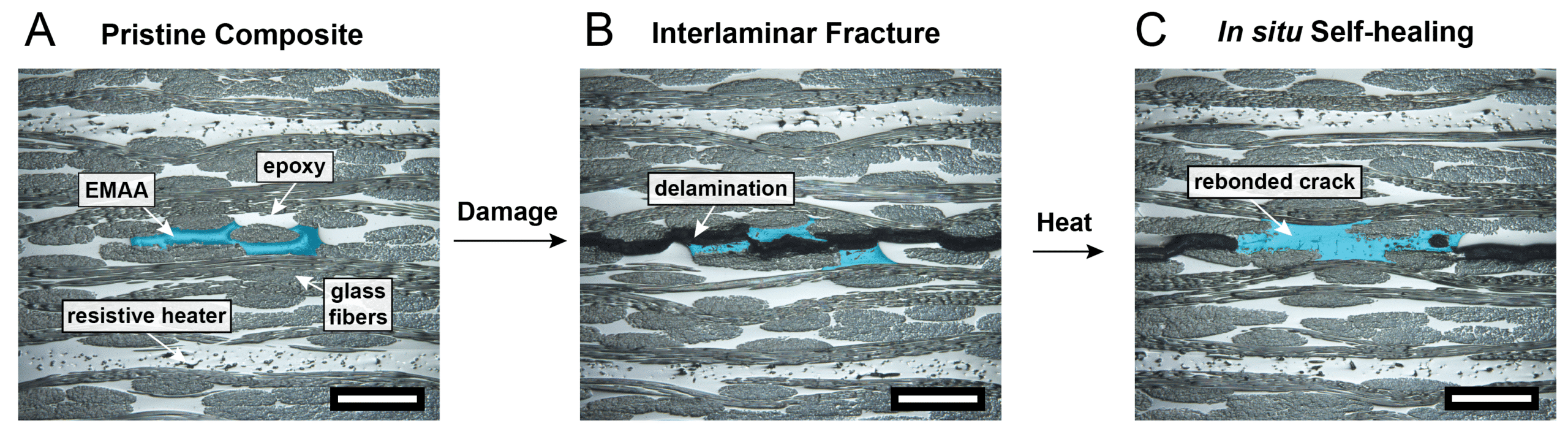
To assess long-term healing performance, the team recently designed an automated testing system. Tensile force was repeatedly applied to an FRP composite until it delaminated, and developed a crack that was 50 millimeters, which triggered the thermal remending process. Over 40 continuous days, the testing system ran 1,000 fracture-and-heal cycles, measuring the material’s resistance to delamination after each repair. In effect, the researchers cracked the composite in precisely the same way, healed it, and tested how much load it could withstand before separating again — repeating this process 1,000 times, an order of magnitude beyond their previous record.
In real-world applications, healing would be triggered only after damage from hail, bird strikes, or similar events or during routine maintenance. Based on their findings, the researchers estimate the material could remain functional for 125 years with quarterly healing cycles, or up to 500 years with annual treatments.
“This provides obvious value for large-scale and expensive technologies such as aircraft and wind turbines,” Patrick says. “But it could be exceptionally important for technologies such as spacecraft, which operate in largely inaccessible environments that would be difficult or impossible to repair via conventional methods on-site.”
Patrick has patented and licensed the technology through his startup company, Structeryx Inc. “We’re excited to work with industry and government partners to explore how this self-healing approach could be incorporated into their technologies, which have been strategically designed to integrate with existing composite manufacturing processes,” Patrick says.
The paper, “Self-healing for the Long Haul: In situ Automation Delivers Century-scale Fracture Recovery in Structural Composites,” is published in the Proceedings of the National Academy of Sciences. First author of the paper is Jack Turicek, a Ph.D. student at NC State. The paper was co-authored by Zach Phillips, a Ph.D. student at NC State, and Kalyana Nakshatrala, the Carl F. Gauss Professor of Civil and Environmental Engineering at the University of Houston.
This article is based on a news release from NC State University.