Research Roundup: Wearable Sensors and Devices for Human Health
Across NC State’s departments of electrical and computer engineering, biomedical engineering, chemical and biomolecular engineering, and mechanical and aerospace engineering, researchers are designing smarter sensors for human health and safety.

Researchers at NC State University are developing more effective and responsive health technology. These innovative sensors can detect dangers in the environment, measure electrical activity in cerebral tissue for genetic research, or alert health professionals when coughing might signify a critical health risk. Improvements to sensor technology could also make devices more comfortable to wear — and more durable, even in wet conditions. Take a look at how five research teams are engineering sensors for safer societies and improved health outcomes.
Vibrating Alerts for Environmental Hazards

Researchers have engineered a wearable patch that can detect hazards in the environment — such as dangerous gases or heavy metals in water — and then notify wearers by vibrating against their skin.
Smart devices equipped with sensors that detect environmental hazards have been available for years. The researchers instead wanted to improve existing sensors with two goals: to miniaturize them into a wearable patch and incorporate vibrating haptic technology.
“If the notification is being sent to your phone, you may not check it right away. So we wanted to incorporate haptic technology into the patch so that it would vibrate as soon as the hazard was detected, allowing people to respond quickly to the potential threat,” says Erim Uzunoğlu, first author of a paper on the work and a Ph.D. student in chemical and biomolecular engineering at NC State University.
The patch can alert the wearer of six different environmental hazards, each with its own vibration pattern.
Comfortable Electrocardiogram Tech

Medical patients often wear devices that record electrocardiogram (ECG) data, which treatment providers use to diagnose an illness or monitor disease progression or recovery. However, existing sensors are held in place with a gel adhesive that can irritate the skin. Also, the effectiveness of the signal an electrode transmits often degrades as the gel dries.
The researchers developed a gel-free and stretchy elastomer that’s conductive and able to pick up ECG signals. It is strong enough to bear the weight of the wires that transmit ECG readings, but it can still be peeled off comfortably.
“Our goal was to create a polymer electrode that is comfortable to wear, adheres to the patient’s skin and can get an accurate reading without using gels or adhesives,” says Kirstie Queener, first author of a paper on the work and a Ph.D. candidate in the Lampe Joint Department of Biomedical Engineering at NC State and the UNC-Chapel Hill.
Cost-Effective Innovations for Studying Genetic Disorders
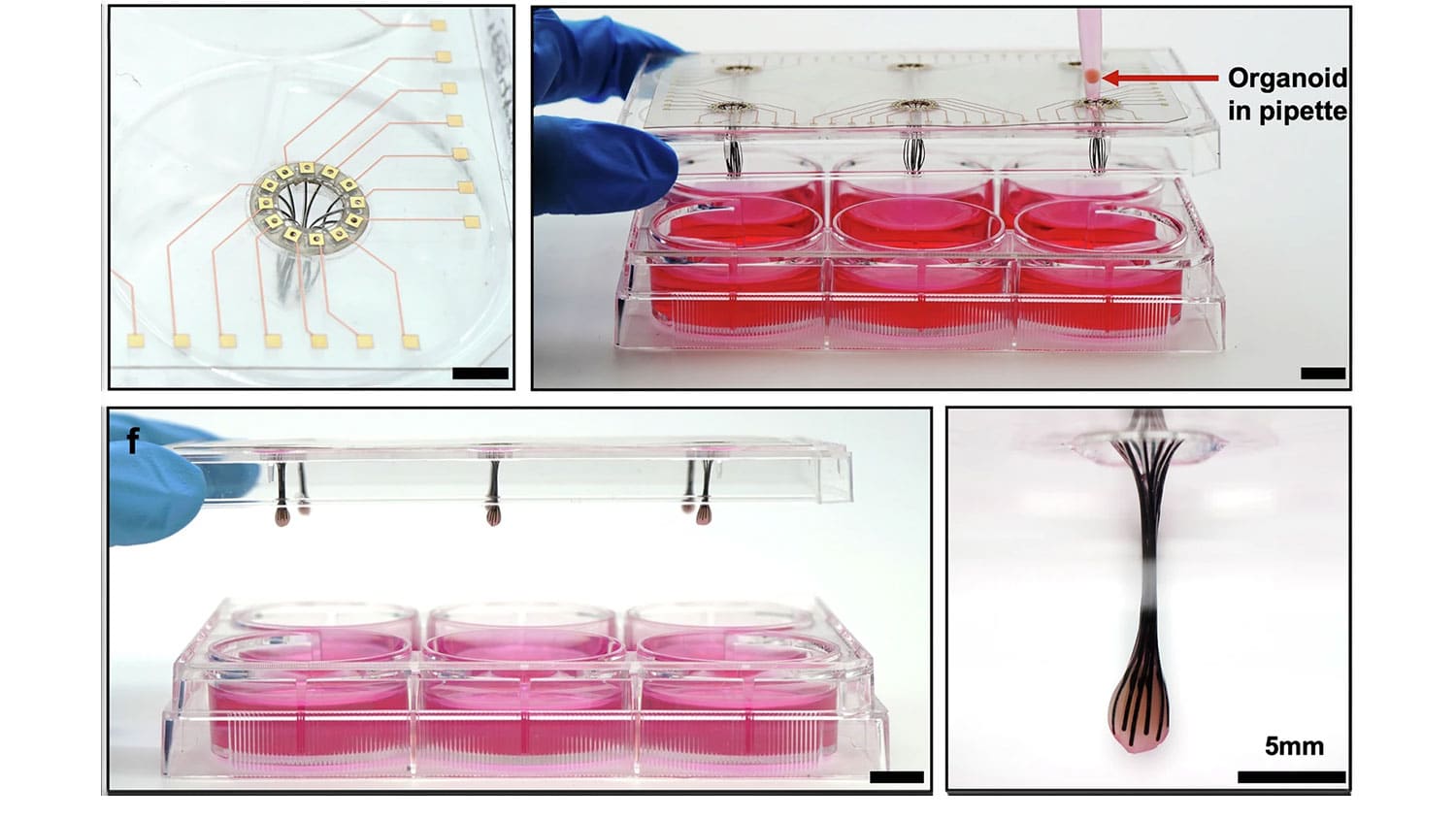
To better understand brain function in neurodevelopment and genetic disorders, researchers depend on tiny, lab-grown cerebral organoid tissues that mimic the human brain structure. The tricky part is documenting electrical activity — a crucial measure of how brain cells function. Existing technologies for measuring electrophysiology are expensive and limit sample sizes, making it difficult to account for the natural biological variations among organoids.
To address this challenge, NC State researchers have developed a new class of low-cost sensors that track electrical signals. The device — called CAMEO, which stands for Conformal Array for Monitoring Electrophysiology of Organoids — integrates microelectrode arrays made up of carbon nanotubes. Hanging from a lid, they can be placed directly over petri dishes of cell cultures. This “plug-and-play” system allows scientists to record electrical signals from many organoids simultaneously without needing complex, specialized laboratory workflows.
“Our goal with this work was to develop a sensor that performs well, can be scaled up in an affordable way, and that is easy to use,” says Albert Keung, co-corresponding author of the paper on the work and an associate professor of chemical and biomolecular engineering.
Multimodal Advances for Respiratory Health

For patients with certain respiratory diseases, coughing is an important indicator of chronic health conditions and risks like asthma attacks. At-home cough monitoring systems have been available to consumers for over a decade, but they have limitations.
“While models have gotten very good at distinguishing coughs from background noises, they often struggle to distinguish coughs from speech and similar sounds such as sneezes, throat-clearing or groans,” says Edgar Lobaton, the corresponding author of a paper on the work and a professor of electrical and computer engineering.
To address this challenge, the researchers explored using two types of health monitors, strapped to the chest, that combine audio detection with a separate accelerometer to measure movement.
“Movement alone cannot be used to detect coughing, because movement provides limited information about what is generating the sound. Different actions – like laughing and coughing – can produce similar movement patterns,” says Yuhan Chen, first author of the paper and a recent Ph.D. graduate from NC State.
“But the combination of sound and movement can improve the accuracy of a cough-detection model, because movement provides complementary information that supports sound-based detection.”
Waterproofing Sensor Technology

A challenge in creating biomedical sensors is ensuring they can perform in wet environments. A team of researchers demonstrated a technique for creating sensors that can function both in air and underwater. The approach paves the way for “amphibious” sensors with applications ranging from wildlife monitoring to biomedical applications.
“Our goal with this work was to create sensors that would last a long time in a wet environment without sacrificing the performance of the sensor,” says Shuang Wu, first author of a paper on the work and a postdoctoral researcher at NC State.
The new findings are focused on strain sensors, which measure deformation – meaning they can be used to measure how things stretch, bend and move. For biomedical applications, this ability could assist in measuring the behavior of blood vessels and other biological systems.

The research team developed a sensitive strain sensor that they sandwiched between two thin films made of a highly elastic, waterproof polymer — giving the sensor the desired sensitivity and stretchability. The sensor can be connected to a small chip that transmits data wirelessly.
“We found that the performance of the sensors was the same whether the sensor was in air or after being submerged in saltwater for 20 days,” says Wu.

- Categories:


